
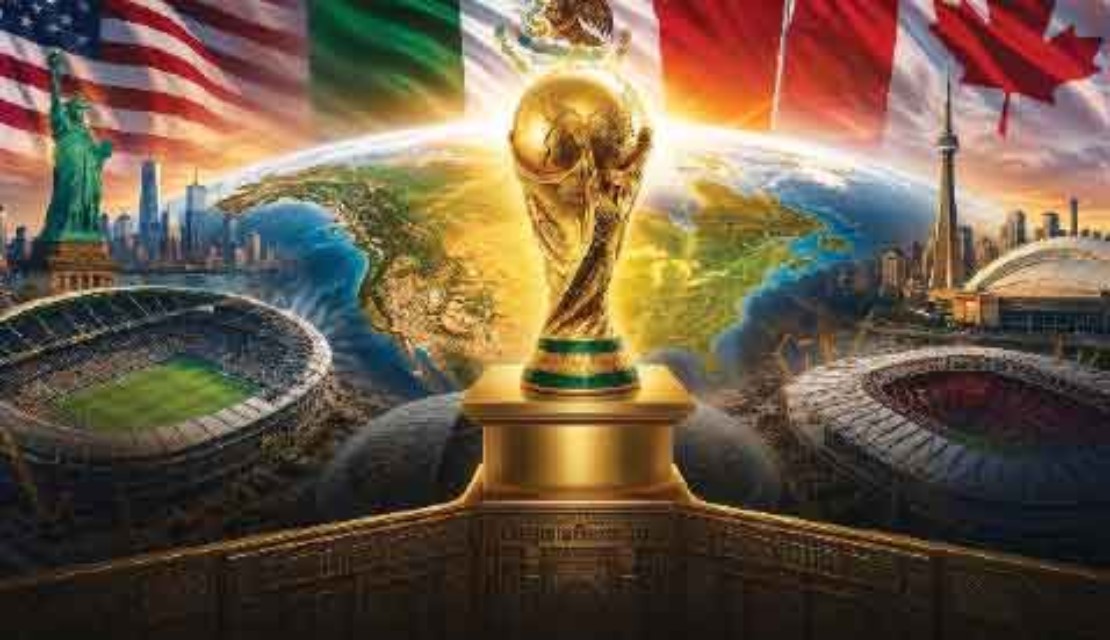
On June 11, 2026, the global axis will shift toward the North American continent. For thirty-nine days, the traditional metrics of geopolitical power will be momentarily eclipsed by the flight of a ball. The 2026 FIFA World Cup, a gargantuan undertaking spanning three nations, sixteen cities, and forty-eight teams, represents more than just the expansion of a sporting tournament; it is a profound sociological experiment in unity and a high-stakes arena for the projection of soft power.
For the academic observer and the seasoned sports enthusiast alike, this edition of the World Cup arrives at a critical juncture in human history. As the international community grapples with the centrifugal forces of isolationism and cultural fragmentation, football emerges as a universal grammar, a shared language that, despite its competitive edge, reinforces a collective human identity. This is the ‘Greatest Show on Earth’, but in 2026, the stage is larger, the stakes are higher, and the narrative is more complex than ever before.
The Hegemony of the Hexa: Brazil’s Perpetual Burden
Every four years, the world looks toward the yellow and green of Brazil as the default benchmark of excellence. With five stars stitched above their crest, the Seleção carries a historical weight that no other nation can match. However, Brazil enters the 2026 cycle in a state of tactical and existential reflection. The perennial question, Will they win the Hexa? is no longer just about talent; it is about the reconciliation of Joga Bonito with the rigid, high-intensity structuralism of the modern European game.
In recent iterations, Brazil has found itself victimized not by a lack of skill, but by a systemic efficiency gap. While the individual brilliance of players like Vinícius Júnior, Raphinha and Rodrygo remains unparalleled, the Brazilian project has often faltered against the low-block/high-transition architectures of European powerhouses. For the 2026 campaign, the focus shifts to whether Brazil can integrate its inherent aesthetic flair with the data-driven defensive discipline required to navigate a 104-match tournament. Brazil remains the favorite not because of their past, but because of their unique capacity to produce chaos-players who can break the most sophisticated tactical systems. Yet, as history has shown, the gap between being the favorite and being the champion has never been wider.
The Defending Paradigm: Argentina and the Institutionalization of Success
The narrative of the 2022 World Cup was dominated by the messianic arc of Lionel Messi. In 2026, however, Argentina arrives as something more formidable: a settled institution. Under the stewardship of Lionel Scaloni, the Scaloneta has moved beyond being a vehicle for a single genius and has become a blueprint for collective resilience. Argentina currently sits atop the global power rankings, not merely through sentiment, but through a masterful balance of veteran experience and emerging tactical versatility.
The transition from the Messi-centric era to a post-Messi or late-Messi reality is the central academic curiosity of this tournament. Argentina has successfully institutionalized a culture of winning that was absent for thirty-six years. With a midfield anchored by tireless engines and a defense that thrives on psychological warfare, Argentina represents the pinnacle of pragmatic excellence. Their opening fixtures against Algeria and Austria will serve as a litmus test: Can they maintain the hunger of the hunter while occupying the throne of the prey? Argentina’s performance will demonstrate whether a culture of unity, forged in the fires of 2022, can survive the inevitable decay of a
championship cycle.
The European Meritocracy: France’s Factory and the Continental Chasing Pack
While South America holds the trophy, France holds the keys to the future. The French footballing infrastructure, often described as a factory of elite talent, remains the most robust in the world. Centered around Kylian Mbappé, the Les Bleus project is a masterclass in depth. France does not just field a team; they field an ecosystem. Their ability to reach the final in two consecutive tournaments (2018 and 2022) is an anomaly in the modern era of high-variance competition.
However, France is not alone in its European dominance. The 2026 landscape features a resurgent Spain, whose victory in Euro 2024 signaled a shift away from the sterile possession of the Tiki-Taka era toward a more vertical, lethal attacking philosophy. Germany, under the intellectual rigor of Julian Nagelsmann, is undergoing a DNA restoration, moving away from the identity crisis of the last decade toward a system centered on the precocious talents of Jamal Musiala and Florian Wirtz.
Meanwhile, England enters the North American summer with a squad that is, on paper, perhaps the most balanced in its history. The English challenge remains psychological, the transition from perennial contenders to ruthless finishers. Across the border, Portugal navigates the twilight of the Cristiano Ronaldo era, possessing a roster of such technical depth that their greatest challenge is no longer finding talent, but managing the egos of a golden generation that must now define itself through collective cohesion rather than individual idolatry.
The 48-Team Dilemma: Democratization vs. Dilution
The most significant structural shift in 2026 is the expansion to 48 teams. From an academic standpoint, this is a classic case study in the neoliberal expansion of global brands. By increasing the participant pool by 50%, FIFA is effectively democratizing the tournament, providing a platform for the Global South and emerging footballing nations that were previously excluded by the rigid quotas of the 32-team format.
This expansion will lead to a dilution of quality in the group stages. However, a more sophisticated analysis suggests that the expansion serves a deeper geopolitical purpose. Football is a primary tool of diplomacy. When nations like Uzbekistan, Jordan, or Haiti compete on the world stage, it facilitates a level of national recognition and internal pride that few other diplomatic maneuvers can achieve. The 12-group format, with 72 group-stage matches, ensures that the World Cup is no longer an elite club, but a truly global congress. The lesson of unity here is practical: by bringing more voices to the table, the tournament mirrors the multipolar world of the 21st century.
Tactical Geographies: The Death of the Individual?
The tactical evolution of 2026 is a source of intense fascination. We are witnessing the gradual death of the traditional No. 10, the playmaker in favor of systematic fluidity. The modern pitch is no longer divided by positions, but by zones of influence. The rise of inverted fullbacks, high-intensity Gegenpressing and the use of half-space specialists has turned football into a game of high-speed chess.
In this environment, the individual brilliance of a player like Brazil’s Vinícius or France’s Mbappé is only effective if it is integrated into a collective defensive block. The 2026 World Cup will likely be won by the team that best utilizes data analytics to manage the physical workload of an expanded schedule. With the possibility of playing eight matches to reach the final (instead of the traditional seven), squad rotation and sports science become as important as the manager’s halftime talk. We are entering an era of Total Efficiency, where the margins of victory are measured in centimeters and milliseconds.
The Sociology of the Beautiful Game: A Lesson in Harmony
Beyond the tactics and the trophies, the 2026 World Cup is a celebration of human culture and harmony. The decision to host the tournament across the United States, Mexico, and Canada, three nations with distinct political identities and complex shared histories is a powerful symbolic gesture. At a time when borders are often seen as points of contention, the United 2026 bid presents them as bridges. People have waited four years for this moment, but the wait is about more than just the sport. It is about the ritual of the gathering. Every World Cup brings a pattern where the stadium becomes a microcosm of the world. In the stands of the MetLife Stadium or the Estadio Azteca, the barriers of language and religion dissolve into a shared roar of anticipation. This is the friendliness the user speaks of, a profound, if temporary, suspension of the world’s animosities in favor of a shared narrative.
The cultural impact on the host nations will be equally significant. In the United States, football (soccer) is no longer a niche sport but a growing cultural force that reflects the country’s increasing diversity. In Mexico, the tournament is a homecoming for a nation where football is a secular religion. In Canada, it is a marker of the country’s emergence as a genuine sporting power. Together, these three nations provide a canvas for a New World footballing identity.
The Universal Language
As June 11 approaches, the noise of speculation will reach a fever pitch. Will Brazil finally reclaim their throne? Can Argentina maintain their hegemony? Will the French factory produce another masterpiece, or will the sleeping giants of Germany and England finally awake? These questions drive the drama, but they do not define the significance.
The 2026 World Cup is an invitation to witness the human spirit in its most vibrant form. It is a study in globalization and soft power. It is an odyssey of emotion and skill. But for the world at large, it is a reminder that we are capable of creating something beautiful together.
In a world that often feels like it is pulling apart at the seams, the simple act of twenty-two players chasing a ball across a patch of grass offers a counter-narrative of unity. It teaches us that while we may wear different colors and sing different anthems, we are all part of the same ‘Greatest Show on Earth’. When the first whistle blows on June 11, the world will not just be watching a game; it will be watching itself, striving for excellence, navigating conflict with grace, and finding, in the beautiful game, a reason to believe in the possibility of a harmonious future.