
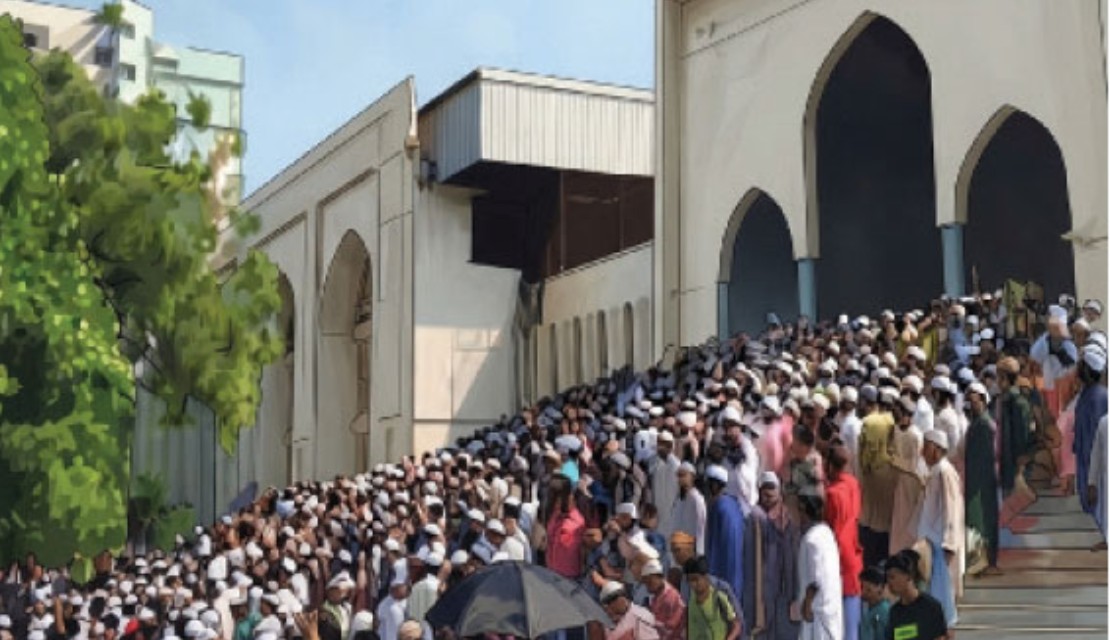
In the political history of Bangladesh, few organizations have the kind of on-the-ground presence that Islamist organizations have kept for decades. From campus dormitories to neighborhood mosques, from charity drives during floods to student welfare programs during exams, their footprint is visible. Yet, despite this grassroots reach, Islamist political and social narratives have repeatedly struggled to become the dominant story of the nation.
This paradox became even more evident after the "July 2024 mass uprising," popularly known as the "anti-quota movement," which toppled the long-standing Awami League government of Sheik Hasina. That movement was led largely by students, and it brought together people of different ideological backgrounds under one demand: reform, accountability, and an end to authoritarianism.
However, since that moment, many expected Islamist student groups, such as 'Bangladesh Islami Chhatra Shibir,' to lead the national conversation to develop a new Bangladesh. However, over time, the broader narrative slipped away from them.
Why does this happen? Why do groups with strong grassroots networks, disciplined cadres, and clear moral messaging fail to own the national narrative in Bangladesh?
The Paradox of Grassroots Strength vs. Narrative Weakness
In Bangladesh, as the general people often look for getting some service delivery, hence, Islamist organizations have built credibility through direct work. For example, during disasters, they distribute relief. Besides, on campuses, Islamic organizations like Islami Chhatra Shibir run book fairs, blood donation camps, and tutoring programs. Their stated goal, as articulated in many of their publications, is to build “a nation of honest, efficient and competent people,” starting with students.
Now, the truth is, this service model creates loyalty at the local level. A student who receives free admission help or medical aid remembers that. A family that gets food during a flood remembers that.
However, truly, the national narratives are not built solely on service. Rather, they are built on media framing, elite consensus, international perception, and historical storytelling. Here, unfortunately, Islamist groups face structural disadvantages. Secular-liberal voices have historically dominated the major television channels, English newspapers, and Dhaka-based think tanks. When a story breaks, the first frame often comes from those spaces.
As various newspapers noted during the July 2024 protests, “Students from all universities and backgrounds came together under the banner of reform.” Here, the coverage highlighted diversity, but rarely centered on any single ideological group, even though Chhatra Shibir leaders were present in many campuses. Thus, it proves that service literally gives you trust; however, it does not automatically grant you authorship of the national story.
The July 2024 Uprising: A Case Study in Narrative Building in Politics
For instance, let us consider the anti-quota movement of July’24 as crucial to understanding this dynamic. It started with a student demand to reform the government’s job quota system. Within weeks, it had grown into a larger protest Hasina’s “fascist” government.
Factually, three factors mattered here:
Firstly, the movement was leaderless (with no identified leaders) and platform-based only. All kinds of social media, especially Facebook and TikTok, allowed memes, videos, and slogans to spread faster than any organizational structure. In that environment, disciplined organizations had less advantages than viral content creators.
Secondly, the movement deliberately avoided any ideological branding. Students chanted for “justice” and “reform,” not for religious or secular slogans. Undoubtedly, this was strategic and worked excellently. After 15 years of polarized politics, many young people were tired of being labeled. They wanted a civic, not sectarian, identity.
Thirdly, anti-Islamic coalitions were quick to frame the story. As soon as Islamist students appeared in protests, certain media outlets and political actors warned of “infiltration” or “hijacking.” Several international outlets ran pieces questioning whether the protests would “turn religious.” Luckily & interestingly, even without evidence, the suspicion itself became part of the narrative.
Here, Islami Chhatrashibir tried to respond by emphasizing its role in discipline, protecting protesters, and providing aid. Their social media pages shared images of members cleaning campuses and helping the injured. But in a 24-hour news cycle, the counter-frame of “Islamists trying to take over” traveled faster. By the time the Hasina government fell in August 2024, the story of the uprising had been written largely as a “student-citizen” victory, not an ideological one.
How do Secular and Nationalist Groups Succeed where Islamists Struggle?
Now, words come to discuss what “political narrative” means to make way to understand the legacy of the struggle of Islamist in Bangladesh for being an identifiable identity.
Disturbingly, no discussion of Islamist politics in Bangladesh can ignore 1971, despite its irrelevance. As the Liberation War remains the founding myth of the Bangladeshi state, so any group perceived as distant from that narrative starts with a credibility deficit.
In this fact, Islamist parties, including Bangladesh Jamaat-e-Islami and Bangladesh Islami Chhatra Shibir, have spent decades trying to moderate with this history. They point to post-1990 contributions, to their role in education, and to their condemnation of violence. But with evil intentions, opponents regularly return to 1971 in public debate, realizing their defeat.
Hence, this creates what political scientists call a “discursive trap.” Because when Islamists talk about corruption or governance, critics shift the conversation to history. When Islamists talk about youth and competence, critics ask about ideology. The result is that their preferred narrative–“we are about honesty, efficiency, and service”–rarely gets to stay on stage.
However, surprisingly, this pattern repeated after July 2024. As the interim government took shape, debates about constitutional reform and transitional justice dominated the agenda. Islamist groups proposed ideas about anti-corruption and moral education. But newspaper op-eds and TV talk shows spent more time asking, “What is their position on 1971?” The historical question drowned out the governance question.
Grassroots Strengthening through Narrative Building Politically (successes through barriers)
Today’s Bangladesh is more than young. Over 60% of the population is under 35. This generation grew up with the internet, global pop culture, and a strong sense of Bangladeshi nationalism that is not necessarily tied to religion or secularism alone.
To this generation, from Islami Chhatra Shibir, the core message has been consistent: build character, resist corruption, serve people, and prepare competent leadership. In campus pamphlets and meetings, leaders often say they want “honest, efficient, and competent people’s representatives.” That definitely resonates with students frustrated by nepotism and bribery.
Now, in terms of achieving the Grassroot Strength, translating that campus message to a national narrative is hard for three reasons:
1. Language and symbols: The words “Islamic” and “Shibir” trigger immediate associations in media and among elites. Even when the content is about road safety or exam help, the label shapes how it is received.
2. Coalition politics: In Bangladesh, no group wins alone. To govern, you need alliances. But secular parties are reluctant to be seen with Islamists, and Islamists are wary of diluting their identity. So, they remain outside the main coalition tables where narratives are negotiated.
3. Counter-narratives: Organized campaigns on social media often label any Islamist visibility as “extremism.” Fact-checkers and civil society groups sometimes amplify this. It creates a chilling effect in which moderate voices self-censor to avoid controversy.
During July 2024, Shibir members were on the streets alongside others. But when the movement won, the credit was distributed to “the people” or “Gen Z.” That is democratic, but it also meant that the specific organizational story of Shibir did not enter textbooks or prime-time retrospectives.
Media, Algorithms, and the Power to Define: The way that Tests Narrative Power
Bangladesh’s political story since independence has been written largely in the language of two big secular-nationalist traditions. Yet beneath that dominant narrative, another current has continued to organize, teach, and serve at the grassroots: the Islamist current, led most visibly among students and youth by Bangladesh Islami Chhatra Shibir and, in wider society, by Bangladesh Jamaat-e-Islami. Both organizations claim a simple mission: to build a nation of honest, able, and hardworking people, starting with character formation in schools, colleges, and universities.
Islamist groups tend to communicate in longer formats: speeches, pamphlets, and study circles. That works for cadre training. It does not work for virality. Meanwhile, opponents can post a 15-second clip with a caption like “Watch out” and reach a million people.
However, after the uprising, several content creators unaffiliated with any organization became national voices. They spoke the language of memes and sarcasm. Shibir’s official pages, by contrast, posted statements and photos of relief work. Important, but not algorithm-friendly, unfortunately.
As a result, it was believed that the narrative of July 2024 was curated by influencers, journalists, and international media, rather than by the organizations with the most cadres on the ground.
Translating Moral Work into Political Language: challenges of becoming Discursive instead of organizational
It would be wrong to say Islamists have “failed.” They continue to run schools, charities, and student networks, in addition to recruiting. After July 2024, the political space opened up, and Islamic organizations publicly re-emerged on campuses after years of restrictions, as they have real influence.
But “influence” and “narrative dominance” are different. To dominate the narrative, a group needs three things:
● Control of storytelling platforms,
● Allies in elite institutions, and
● A story that fits the country’s founding myth.
Currently, Islamist groups in Bangladesh have strength at the grassroots, but not at the national media level. Hence, to overcome this, they must focus on crucial factors. They must find a way to avoid the Burden of Historical Framing and get strong in Media Access and the Digital Battlefield. Thus, the comparative lesson we can draw from that narrative is that it requires more than foot soldiers. Rather:
● Storytelling infrastructure matters.
● Framing the issue before others frame you is crucial.
● And service must be visible and documented.
Beacon of Success ahead of Islamist in Bangladesh
The July ’24 Revolution showed that Bangladesh is about to start drafting its story in a new way. The question now is who gets to write the chapters. The Islamists, or the evil gongs?
Need to realize that the grassroots power gives you presence, while narrative power gives you direction. Undoubtedly, in Bangladesh, Islamists have the first. Whether they can build the second will depend less on street numbers and more on how well they can tell a story that the whole nation, including its skeptics, is willing to hear!
Again, the July ’24 uprising proved two things. First, Bangladeshi students will not accept a system they see as unfair. Second, no single organization can claim to own a spontaneous national movement.
Hence, for any Islamic organizations, even like Islami Chhatra Shibir or Jamaat-e Islami, the path forward is not about abandoning grassroots work. It is about translating that work into a public language that students and parents outside their circles can immediately understand.
For instance, that could look like:
● Policy papers by students, for students;
● Ethics campaigns tied to national events;
● Digital archives of service;
● Dialogue forums through inviting students from different backgrounds to debate what an able and hardworking Bangladesh is, without preconditions.
The goal would be to make the Islamist contribution visible without making it sectarian. The July movement showed that “honesty” and “merit” are national values, not party values.