

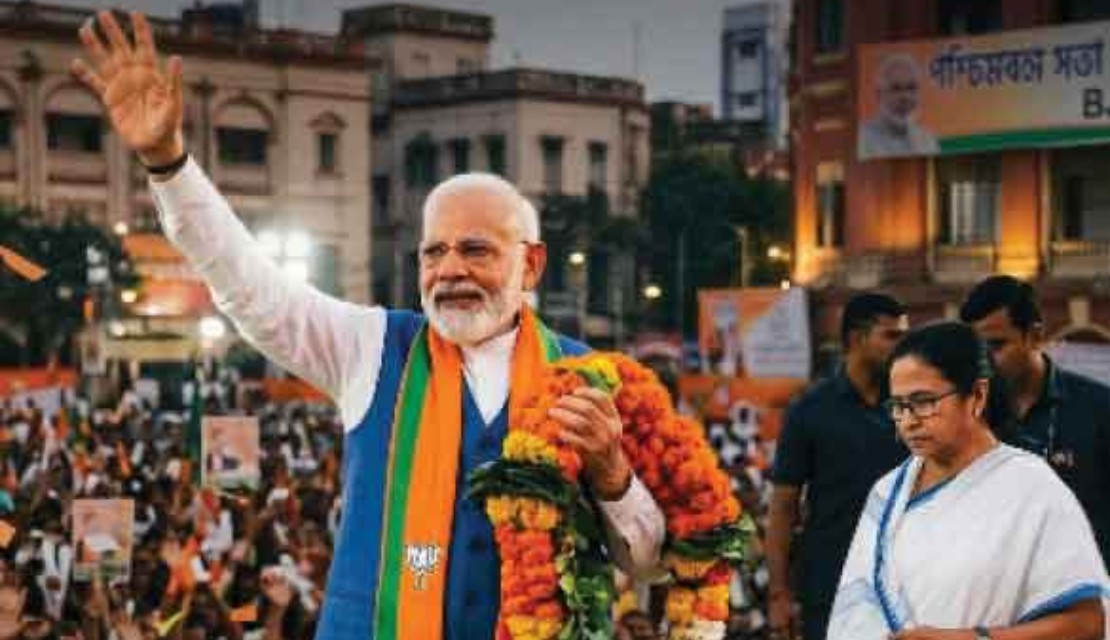
The political cartography of South Asia has undergone a seismic shift, one that transcends the mere tallying of ballots in a provincial capital. With the definitive ascent of the Bharatiya Janata Party (BJP) in the 2026 West Bengal assembly elections, the "saffron tide" has finally breached the last major fortress of the eastern sub-continent. This is not only a localized change of guard in Kolkata but also an ideological transformation with the potential to fundamentally reorder the geopolitical architecture of the region. For Bangladesh, a nation inextricably bound to West Bengal by the sinews of history, language, and geography, this victory signals the arrival of a profound existential and strategic challenge.
The fall of the Mamata Banerjee era and the consolidation of BJP power on both the eastern and western flanks of Bangladesh in Assam and now West Bengal represents the completion of an ethno-nationalist encirclement. What was once a buffer of secular, linguistic-based politics has been replaced by a rigid, ideological monolith. As the dust settles on the 2026 polls, the implications for Dhaka are not diplomatic, they are systemic, threatening to destabilize the delicate equilibrium of trade, water security, and social cohesion that has defined the bilateral relationship for decades.
The Specter of Manufactured Statelessness: NRC, CAA, and the "Rohingya-fication" of the Border
At the heart of the BJP’s triumphant march lies a political philosophy anchored in the National Register of Citizens (NRC) and the Citizenship Amendment Act (CAA). These are not domestic administrative tools; they are instruments of demographic re-engineering. The rhetoric of the 2026 campaign, defined by the identification of "intruders" and "infiltrators" suggests a looming humanitarian crisis that mirrors the tragic dispossession of the Rohingya in Myanmar.
The systematic disenfranchisement observed during this election cycle is chilling. Reports indicate that approximately 9.2 million voters were purged from the rolls under the guise of "Strict Revision" (SIR). In many instances, the victims are those whose lineage in the soil of Bengal predates the British, including descendants of the historical aristocracy. By labeling these individuals as "foreigners," the new administration in Kolkata, backed by the central apparatus in Delhi, is creating an artificial crisis of statelessness.
From a strategic perspective, the threat to Bangladesh is twofold. First, there is the immediate risk of a "push-in" strategy. Much like the Myanmar junta stripped the Rohingya of their identity to justify their expulsion, a hardline ideological shift in West Bengal could lead to the forced migration of millions toward the Bangladeshi border. Dhaka, already straining under the weight of over a million refugees from Arakan, lacks the economic and social infrastructure to absorb a second, even larger wave of displaced persons. Such a scenario would not only be a humanitarian catastrophe but a "time bomb" for regional stability, potentially fostering the very radicalization that the BJP claims to oppose.
The "Double-Engine" Squeeze: Economic Hegemony and the Gateway Crisis
West Bengal has historically served as Bangladesh’s primary economic corridor to the Indian mainland. A significant portion of Bangladesh’s essential imports from onions to industrial raw materials flows through the land ports of Petrapole and Hili. However, the rise of a "double-engine" government (where the same party holds power in both the state and the center) introduces a new, coercive dimension to trade.
The consolidation of BJP power will allow Delhi to exert unprecedented leverage. The era of "provincial obstructionism" that occasionally shielded Bangladesh from central pressure is over. Now, trade flows could be weaponized. We may see a "quid pro quo" diplomacy where essential commodities or water-sharing agreements are held hostage to strategic concessions, such as the unfettered use of Bangladeshi ports or alignment on sensitive defense issues.
Furthermore, a structural shift is occurring within the West Bengal economy. The shift of administrative and commercial control from traditional Bengali elites to non-Bengali capital interests aligned with the Hindi-speaking heartland threatens to sever the cultural and linguistic "soft power" that eased trade relations. For Bangladeshi entrepreneurs, the predictability of the Kolkata market is being replaced by an opaque, ideological bureaucracy that prioritizes nationalistic alignment over mutual commercial benefit.
Hydro-Politics: The Teesta and the Death of Diplomatic Optimism
For over a decade, the Teesta River water-sharing agreement has been the "holy grail" of Indo-Bangla diplomacy, perpetually stalled by the objections of the West Bengal state government. A naive school of thought suggested that if the BJP took Kolkata, the friction between the state and the center would vanish, leading to a swift resolution. The 2026 reality, however, suggests a far more cynical outcome.
The Teesta has evolved from a diplomatic dispute into a permanent fixture of India’s domestic electoral calculus. The West Bengal BJP, now beholden to an agricultural vote bank in the northern districts, is unlikely to release water that could be framed as a "surrender" of provincial resources. In this new political climate, water is a "trump card." By maintaining the status quo, the BJP can satisfy its local constituents while keeping Dhaka in a state of perpetual hydrological insecurity. This is not a technical failure; it is a direct threat to Bangladesh’s food security and the livelihoods of millions of farmers in the northern delta.
The Assam Blueprint and the Shadow of "Bulldozer Justice"
To understand the future of West Bengal, one must look at the laboratory of Assam. Under the leadership of Hemanta Biswa Sarma, Assam has pioneered a form of frontier politics that marginalizes the minority voice through constituency delimitation and aggressive rhetoric. The 2026 results in Assam, where Muslim representation has been systematically diluted from 35 to roughly 22 seats, provide a grim roadmap for West Bengal.
The rhetoric of "Bulldozer Justice", a term borrowed from the punitive demolitions in Uttar Pradesh and Madhya Pradesh is now a palpable threat on Bangladesh’s doorstep. This policy, which critics compare to Israeli punitive tactics in the Levant, uses administrative power to physically erase the presence of those deemed "outsiders" or "protesters." When leaders like Shuvendu Adhikari adopt the persona of "Yogi 2.0," they are signaling an era of communal polarization where the state no longer acts as a neutral arbiter but as a vanguard of "ethnic purity."
Perhaps most concerning is the "nightfall strategy" described by high-ranking officials in Assam, the practice of pushing suspected "illegal immigrants" across the border under the cover of darkness to bypass official diplomatic channels. This subversion of international law not only violates the sovereignty of Bangladesh but also signals a breakdown in the institutional trust between the Border Guard Bangladesh (BGB) and the Border Security Force (BSF).
The Cultural Erasure: Defending the Bengali Soul
The political shift in West Bengal is also a cultural crisis of the highest order. For centuries, Kolkata has been the intellectual heartbeat of the Bengali-speaking world, a bastion of liberal thought and syncretic culture. However, the 2026 victory marks an acceleration of what analysts call the "invasion of the Hindi heartland."
The promotion of an "Akhand Bharat" (Greater India) ideology and the creeping dominance of Hindi language and culture in the administrative corridors of Kolkata threaten to dilute the unique identity of the Bengali nation. If the arts, literature, and intellectual discourse of West Bengal are forced into a narrow, religious framework, the global appeal of the Bengali language will be severely diminished. For Bangladesh, this is a "soft power" catastrophe. The historical dialogue between the intellectuals of the "two Bengals" is being replaced by a vacuum, which is increasingly filled by extremist philosophies on both sides of the border.
The BJP’s pledge to implement a Uniform Civil Code (UCC) within six months of taking power in West Bengal is the opening salvo in this cultural war. By repealing Muslim Personal Law, the state is moving toward a homogenization that ignores the historical and religious nuances of the region. This is not just a legal change; it is a psychological blow intended to signal that the minority community’s traditions are no longer welcome in the new "Saffron Bengal."
Strategic Recalibration: Dhaka’s Path Forward
In the face of this "geopolitical storm," Bangladesh can no longer afford a policy of reactive diplomacy. The 2026 reality demands a "Strategic Master Plan" that is both bold and multifaceted.
1. Diversification of Power Alliances: Dhaka must move beyond its traditional over-reliance on a single regional power. To balance the weight of a centralized and ideologically driven India, Bangladesh must strengthen its ties with other global players including the European Union, the United States, and regional blocs in Southeast Asia. This is not about pivoting away from India, but about creating a multi-polar safety net.
2. Internationalizing the Humanitarian Risk: The issues of NRC and CAA can no longer be dismissed as "internal matters" of India. Bangladesh must proactively build public opinion in international forums such as the United Nations and the OIC, highlighting the potential for a manufactured refugee crisis. By framing this as a regional security threat, Dhaka can attract the "preventative diplomacy" of the international community before the first "push-in" occurs.
3. Internal Consolidation and National Consensus: The most effective defense against external ideological pressure is internal stability. Bangladesh must bridge its own political divides to present a unified front on issues of national interest, such as water rights and border security. A fractured domestic polity is an invitation for regional powers to interfere.
4. Economic Resilience and Alternative Gateways: While West Bengal remains the primary gateway, Bangladesh must accelerate its infrastructure projects that connect it to the broader Asian highway and maritime routes. Reducing the "leverage of the land port" is essential for economic sovereignty.
The Turning Point for the Bengali Nation
The 2026 elections in West Bengal and Assam have signaled the end of the post-colonial status quo in South Asia. The triumph of a radical, ethno-nationalist philosophy on Bangladesh’s borders is a "stark warning" that the struggle for rights, culture, and existence has entered a new, more dangerous phase.
We are witnessing a struggle between two visions of the future: one defined by the "politics of hatred and division," and another defined by the rational, modern, and syncretic values that have historically defined the Bengali spirit. For Bangladesh, the task is clear: it must remain a beacon of communal harmony and a rational actor in an increasingly irrational regional landscape.
Ultimately, the defense of Bangladesh’s sovereignty will not just be fought at the border posts or in the halls of the United Nations. It will be fought in the preservation of its culture, the strength of its economy, and the resilience of its people. If the conscious intellectuals and citizens of the "two Bengals" do not unite to build a new resistance against this tide of polarization, the next generation will inherit a region permanently scarred by a "complex game of regional politics" for which they never asked to be players. The time for vigilance is not tomorrow; it is now.