

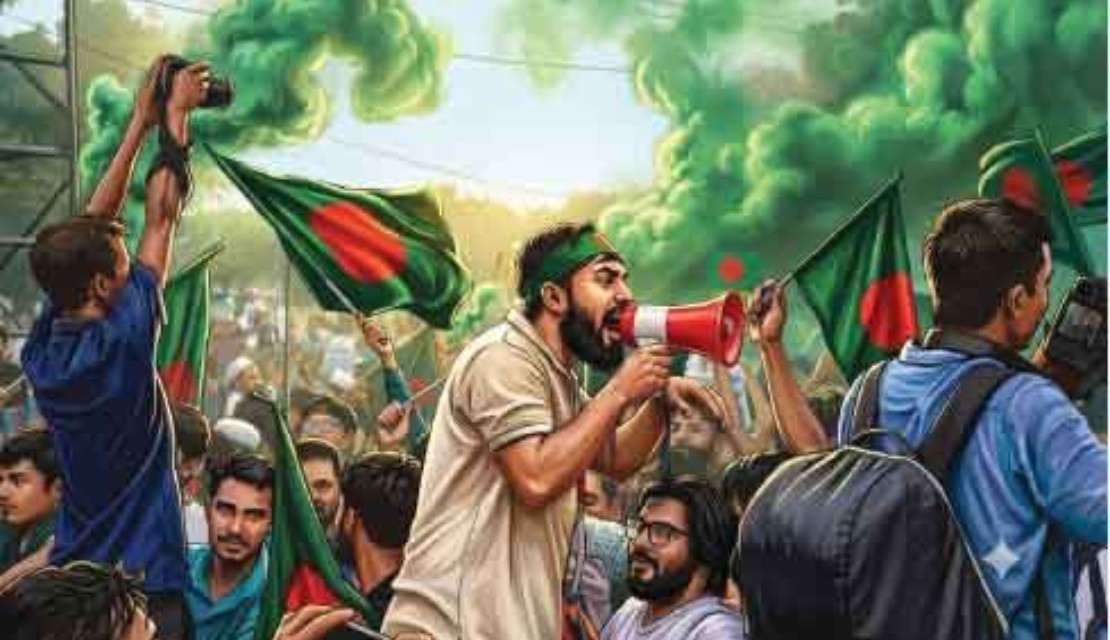
Two years have passed since the political tectonic plates of Bangladesh violently shifted beneath the streets of Dhaka. Looking back from the vantage point of 2026, the unprecedented mass mobilization that consumed Bangladesh from early July to August 5, 2024 immortalized in the collective consciousness as the "July Uprising" remains a masterclass in civic defiance. It was a democratic rupture driven not by seasoned opposition stalwarts, but by disenfranchised students and ordinary citizens who systematically dismantled a draconian, sixteen-year dictatorship. To categorize this merely as a sudden political storm is to misread the deep, structural rot of authoritarianism. The actual detonator of this historic upheaval was activated precisely on June 5, 2024, quietly opening a brutal yet cathartic new chapter in the nation's bloody political evolution.
Under Sheikh Hasina’s iron-fisted tenure, Bangladesh presented a facade of economic miraculousness to the international community. Yet, beneath the glittering mega-projects lay a hollowed-out republic characterized by massive capital flight, institutional subservience, and severe democratic backsliding. The youth, suffocating under systemic patronage, finally reached their breaking point. The trigger was ostensibly bureaucratic: a peaceful student agitation demanding the rationalization of an archaic civil service quota system. However, met with the regime’s characteristically vicious and uncompromising state terror, these isolated campus protests swiftly mutated into a nationwide inferno.
By the end of July, the machinery of state oppression had shifted into its highest, most lethal gear, culminating in the astonishing August 5 spectacle of Hasina abandoning her crumbling fortress and fleeing to India. The human toll was catastrophic. United Nations audits subsequently confirmed that approximately 1,400 lives were extinguished by state-sanctioned violence during this brief, bloody window.
To truly dissect the anatomy of this revolution, one must trace the timeline back to its foundational grievance. In early 2018, ordinary job seekers, galvanized by the Bangladesh General Students' Rights Council, initiated sustained human chains and blockades against a wildly disproportionate public employment framework.
The pressure temporarily broke the government's resolve, leading to the October 4, 2018, executive abolition of quotas for top-tier civil service roles. However, in a provocative judicial reversal on June 5, 2024, the High Court nullified that circular. Overnight, the specter of disenfranchisement returned, reinstating a suffocating 56 percent quota allocation.
The Controversial 2024 Quota Allocation Breakdown
[30%] ▀▀▀▀▀ Descendants of Freedom Fighters (Widely viewed as a patronage tool)
[10%] ▀▀ Women
[10%] ▀▀ Underdeveloped Districts
[05%] ▀ Indigenous Minorities
[01%] ▏ Disabled Individuals
[44%] ▀▀▀▀▀▀▀ Merit-Based (The shrinking sliver for the general populace)
The judicial resurrection of this patronage network acted as a match thrown into a powder keg. Immediate, spontaneous demonstrations erupted across the academic landscape. Dhaka University, the historical vanguard of Bangladeshi political awakenings, immediately transformed into a fortress of resistance on June 6. Students demanded the outright cancellation of the judicial decree, particularly targeting the 30 percent freedom fighter quota, which they argued had been weaponized to bypass meritocracy and embed ruling party loyalists within the state apparatus. The unrest seamlessly bridged the geographic divide, igniting peaceful sit-ins at Jahangirnagar, Rajshahi, Jagannath, and Chittagong
universities.
While the regime cynically appealed the decision to buy time, the youth flatly rejected this judicial theater. On June 9, Dhaka University’s agitators issued a decisive ultimatum: the government had until June 30 to unilaterally terminate the quotas via executive order, or face an uncompromising national blockade. Chittagong and Barisal soon echoed this militancy. A grand delegation subsequently marched on the Supreme Court, serving their memorandum directly to the Attorney General, unfazed by the Appellate Division's
deliberate delay of the hearing to July 4.
deliberate delay of the hearing to July 4.
July birthed a fundamentally different beast. On July 1, the 'Anti-Discrimination Student Movement' was inaugurated. A sophisticated, decentralized network that soon outmaneuvered the state’s intelligence apparatus. Announcing an escalation protocol, they paraded before the Dhaka University central library on July 2. By July 3 and 4, the momentum consumed seven affiliated government colleges. But as the July 4 deadline expired, the state unsheathed its swords. Blood was drawn on the very first day of the escalated blockade, courtesy of orchestrated assaults by the ruling party’s student syndicate, the Chhatra League, acting in lethal concert with militarized police.
The Escalation Matrix (July - August 2024)
| Phase | Date Range | Primary Actor | Strategic Action | Regime Response |
| Incubation | June 5 - June 30 | Student Councils | Legal ultimatums, campus sit-ins | Judicial delays, political dismissal |
| Ignition | July 1 - July 4 | Anti-Discrimination Movement | Coordinated blockades, library marches | Deployment of Chhatra League thugs |
| Conflagration | July 5 - July 18 | Students & Transport Workers | Nationwide strikes, highway closures | Live ammunition, digital blackouts |
| Attrition | July 19 - July 31 | General Public, Professionals | Mass rallies, demanding resignation | Mass rallies, demanding resignation |
| Collapse | August 1 - August 5 | The Masses | Total institutional takeover | Hasina flees |
The Escalation Matrix (July - August 2024)
Between July 2 and July 4, the localized campus skirmishes aggressively metastasized into distant districts, including Chittagong, Khulna, Rajshahi, and even Gopalganj, the deeply entrenched political stronghold of the ruling elite. The socio-economic circulatory system of the country was paralyzed as strategic highways were occupied and railway arteries were severed. Most terrifying for the autocratic establishment was the spontaneous, organic solidarity forged between intellectual student classes and blue-collar transport workers.
When intimidation failed, the regime turned to slaughter. From July 5 to July 12, security forces transitioned to using live ammunition against peaceful assemblies. The epicenters of Shahbagh, Nilkhet, and the TSC intersection drowned in an ocean of defiant humanity. A paralyzing general strike choked the nation. Crucially, the demographic broadened: lawyers, journalists, academics, and corporate professionals publicly declared allegiance to the streets. The Hasina administration desperately attempted to digitally isolate the nation by blacking out mobile networks and broadband internet, aiming to massacre the opposition in the dark. The authoritarian overreach inevitably spilled across borders. On July 13, several Bangladeshi expatriates in the United Arab Emirates were arbitrarily detained and tortured for expressing solidarity, prompting fierce rebukes from international human rights watchdogs. By mid-July, the country was shrouded in a funeral pall. From July 15 to July 18, haunting mass processions clad in black swept through the capital.
The psychological barrier of fear was irrevocably shattered by the blood of martyrs like Abu Sayeed, whose televised execution by police became the moral catalyst of the revolution. By the time a colossal mass rally occupied Shahbag on July 20, the demand for quota reform had been entirely incinerated. The streets vibrated with a singular roar: the immediate resignation of Sheikh Hasina.
Trajectory of State Violence and Casualties
Representing the escalation of fatalities confirmed during the uprising (Estimated)

Representing the escalation of fatalities confirmed during the uprising (Estimated)
Operating in terminal paranoia, the regime’s security apparatus initiated a campaign of nocturnal terror beginning July 25. Under the cover of darkness, student coordinators, dissenting intellectuals, and labor organizers were systematically hunted and disappeared. While widespread panic undeniably rippled through the populace, it bred localized resistance rather than submission. By July 28, credible rumors of the Prime Minister secretly fleeing the country paralyzed the capital, plunging the political elite into chaotic uncertainty.
In a transparent attempt to manufacture a scapegoat, the crippled government utilized an executive order on July 31 to officially ban Jamaat-e-Islami and Bangladesh Islami Chhatrashibir. Analysts universally diagnosed this draconian maneuver as a frantic, intellectually bankrupt attempt to brand a spontaneous youth awakening as an orchestrated militant conspiracy. The masses entirely ignored this desperate bait.
The final collapse was breathtaking. Between August 1 and August 5, the federal authority of the state essentially disintegrated. Students established functional parallel administrative structures, spontaneously managing traffic and local governance. Facing millions marching upon her residence, the architect of a sixteen-year authoritarian nightmare disgracefully fled to India on August 5. The immediate power vacuum was addressed by Army Chief General Waqar-uz-Zaman, who acknowledged the street's victory, promising an impartial investigation. On August 8, state rehabilitation was placed upon Professor Dr. Muhammad Yunus, the Nobel laureate and microfinance pioneer, as Chief Advisor.
Yet, the revolutionary hangover has been deeply painful. The July Revolution fundamentally mutated the political DNA of Bangladesh, permanently injecting the general public into the calculus of power. They demanded an accountable bureaucracy, transparent recruitment, and the utter eradication of impunity. However, the economic devastation was catastrophic.
Macroeconomic Disruption Index
Tracking the immediate economic fallout during and after the revolution.

The Yunus-led interim administration swiftly established the Reform and Consensus Commission, aiming to reconstruct the political framework and cleanse the judiciary and police. However, the bitter reality of 2026 reveals that achieving true judicial independence is agonizingly slow. The stubborn remnants of the old bureaucratic syndicate and a lack of cohesion among traditional political parties have stunted a unified national consensus. The banking sector, hollowed out by oligarchic looting, was rendered comatose. A crippling dollar liquidity crisis and hyper-inflationary spikes continue to degrade daily survival. Promised reforms to end state torture are drafted, yet the security apparatus's institutional muscle memory resists civilian oversight.
The Yunus-led interim administration swiftly established the Reform and Consensus Commission, aiming to reconstruct the political framework and cleanse the judiciary and police. However, the bitter reality of 2026 reveals that achieving true judicial independence is agonizingly slow. The stubborn remnants of the old bureaucratic syndicate and a lack of cohesion among traditional political parties have stunted a unified national consensus. The banking sector, hollowed out by oligarchic looting, was rendered comatose. A crippling dollar liquidity crisis and hyper-inflationary spikes continue to degrade daily survival. Promised reforms to end state torture are drafted, yet the security apparatus's institutional muscle memory resists civilian oversight.
Ultimately, the July-August 2024 uprising was not just a fleeting explosion of anti-incumbent rage; it was a profound, generational awakening against systemic discrimination. It brutally exposed the fragility of dictatorial hubris. Yet, the grueling blueprint for building a new Bangladesh reminds us that violently toppling a regime is infinitely easier than engineering a just, equitable, and internationally legitimate democratic state. The revolution succeeded in breaking the chains; the nation now faces the monumental task of forging the anchor.