

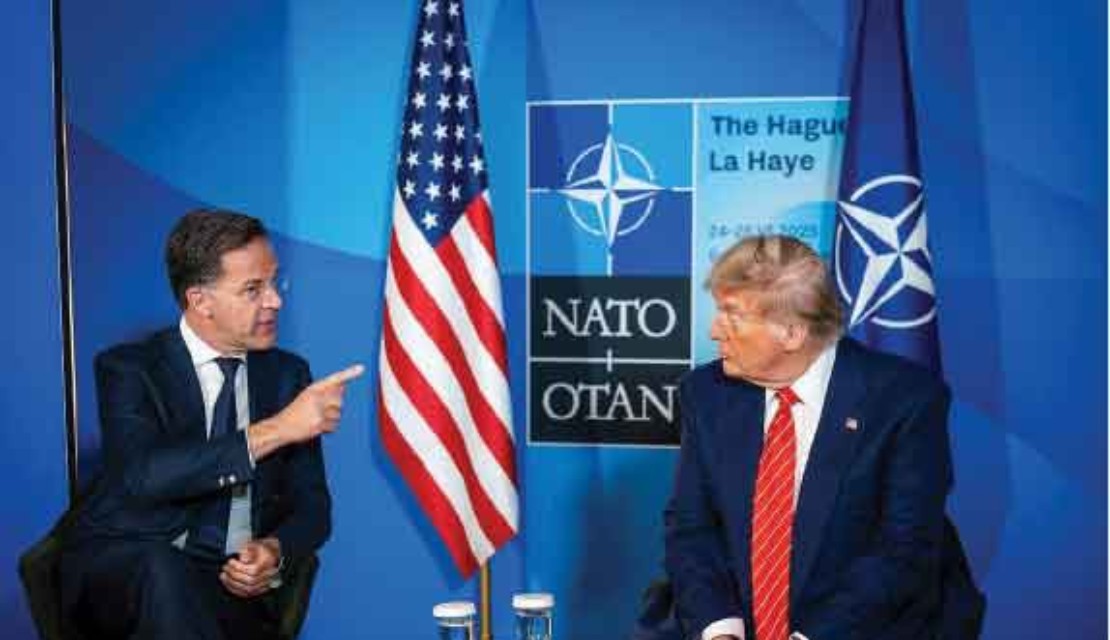
The tectonic plates of the transatlantic alliance have fundamentally shifted, and the tremors were felt at the latest NATO summit in Turkiye. Far from being a routine gathering, the Ankara rendezvous served as a crucible for what strategic planners cautiously christen "NATO 3.0". We are witnessing the transition of a Cold War relic into a hybridized security apparatus forced to navigate a decentralized, multipolar world. The dust settling reveals an alliance undergoing a profound structural metamorphosis, pivoting away from American dependency toward a more polycentric, militarized future. The headline-grabbing announcement of $50 billion in defense agreements is the superficial manifestation of a deeper, systemic recalibration that points irreversibly toward the "Europeanization" of the North Atlantic architecture.
The Transactional Theater and Transatlantic Detente
US President Donald Trump orchestrated a dramatic rapprochement with the host nation, formally rescinding punitive 2020 sanctions imposed on Ankara over its acquisition of Russian air defense systems. The sudden warming of ties, sweetened by Trump’s explicitly stated willingness to finally reintegrate Turkiye into the F-35 fighter jet consortium, highlights a profound shift in Washington’s alliance management strategy. This is not the ideological alliance maintenance of past decades; rather, it is highly transactional diplomacy engineered to secure strategic real estate in a rapidly fragmenting geopolitical landscape. By bringing Ankara back from the cold, Washington is plugging a critical vulnerability on the alliance’s flanks.
The Industrial Polycrisis and the European Arsenal
This localized detente is overshadowed by the sheer scale of collective defense transactions. The flurry of procurement deals, characterized by European capitals buying surveillance drones and the central command authorizing joint aircraft acquisitions, underscores a departure from the strategic complacency of the 2010s. The debate within the alliance has mutated almost unrecognizably since Trump’s initial tenure. During the 2018 Brussels summit, the US commander-in-chief notoriously brandished the threat of outright withdrawal unless the European contingent met the 2 percent GDP spending benchmark. Fast forward to July 2026, and the narrative has been entirely rewritten. European and Canadian allies arrived in Turkiye not as reluctant dependents, but as heavily armed partners, parading a 20 percent year-on-year increase in defense expenditures for 2025.
This $139 billion financial injection permanently alters the burden-sharing equation. Yet, it would be a severe analytical error to attribute this historic militarization solely to the coercive pressure emanating from the Oval Office. While Trump’s abrasive rhetoric undoubtedly fractured the taboo against European rearmament, the genuine catalysts for this monumental spending surge are exogenous. Europe’s strategic awakening is the result of a polycrisis: Russian military assertiveness, state collapse across the Middle East, and anxiety over China’s Indo-Pacific hegemony. The 2022 Russian invasion of Ukraine served as the ultimate historical pivot, shattering the continent's post-historical illusions. It was an existential shockwave that forced Stockholm and Helsinki to abandon generations of calculated neutrality and seek the shelter of the Article 5 umbrella. Consequently, the institutional health of NATO appears robust against the backdrop of an increasingly chaotic global disorder. The alliance is systematically retooling to confront an intimidating horizon of simultaneous internal friction and external kinetic threats. In 2019, French President Emmanuel Macron infamously diagnosed the organization as "brain dead," citing a catastrophic vacuum of strategic coordination.
Today, Macron concedes the Kremlin’s aggression administered an "electroshock". Nonetheless, analytical sobriety requires acknowledging that the remainder of the current Trump presidency will inevitably generate persistent structural friction. Despite the unprecedented financial commitments from the continent, European and Canadian forces remain inextricably tethered to American logistical and command capabilities for the foreseeable future.
This lingering dependency has ignited a venomous internal debate: how should Europe allocate this historic flood of rearmament capital? The dispute is inherently industrial, but its implications are deeply geopolitical. NATO Secretary General Mark Rutte has forcefully championed a "Made in NATO" doctrine, advocating for a seamless era of transatlantic industrial integration that binds North American and European defense supply chains. Conversely, the European Union is ruthlessly pursuing strategic autonomy, vigorously promoting a protectionist "Made in Europe" paradigm designed to incubate a sovereign defense-industrial base capable of operating independent of Washington’s whims. This ideological clash over procurement philosophy threatens to balkanize the very interoperability the alliance requires, setting the stage for a protracted bureaucratic war over the future of the West’s military-industrial complex.
The Strategic Obsolescence of the Cold War Paradigm
Beyond the friction of defense contracts, the Turkiye summit hosted profound deliberations regarding the ultimate strategic teleology of the alliance. The most piercing and consequential framing came from Turkish President Recep Tayyip Erdogan, who expertly utilized his platform as host to demand a radical institutional reimagining. Erdogan articulated a stark truth: the unipolar, Atlantic-centric world that birthed NATO has irreversibly ceased to exist. In its place, a chaotic, multipolar architecture has ascended across the globe, demanding a fundamental and structural repositioning of the alliance’s overarching purpose and daily operations. To double down on archaic containment strategies in this brave new environment, the Turkish leader warned, would be an exercise in strategic futility.
Erdogan’s diagnosis directly channels the ascendant doctrine of strategic expansionism, the ideological core of the so-called NATO 3.0 framework. This concept represents a sweeping institutional reform explicitly engineered to manage the volatility of an increasingly polycentric global order. It signals the abandonment of a purely Euro-Atlantic focus in favor of cultivating a vast web of global security partnerships. Under this new mandate, we are already witnessing Turkiye aggressively accelerating its own bilateral defense synergies with key power brokers across the Middle East, blurring the lines of the traditional alliance boundary and projecting NATO’s footprint indirectly into historically unaligned theaters.
The Indo-Pacific Pivot and the Quadrilateral Axis
However, the most critical geographic pivot for the future of the alliance lies far beyond the Atlantic seaboard. The center of geopolitical gravity has decisively shifted to the vast expanse of the Asia-Pacific. For decades, China has been meticulously constructing a superpower apparatus, and NATO can no longer afford strategic myopia regarding Beijing’s ambitions. Secretary General Rutte recently underscored this existential pivot, delivering a chilling assessment of China’s hyper-militarization, noting that Beijing will possess an arsenal of 1,000 nuclear warheads by 2030. Rutte's explicit warning against strategic naivety fundamentally redefines the alliance's threat matrix. He identified a hostile, coalescing quadrilateral axis comprising China, Russia, North Korea, and Iran as the supreme, overarching, long-term menace confronting the democratic world.
In direct response to this Eurasian authoritarian convergence, NATO has systematically engaged in a diplomatic offensive to militarize its Indo-Pacific partnerships. The deliberate inclusion of officials from Japan, South Korea, Australia, and New Zealand at the Turkish-hosted summit is not symbolic; it is the embryonic formation of a globalized deterrence network. Furthermore, the alliance is aggressively courting New Delhi, seeking to integrate India into a broader, synthesized security architecture that already encompasses the Quad framework with Washington, Tokyo, and Canberra. This eastward expansion of NATO’s strategic calculus represents a historical realignment, acknowledging that Euro-Atlantic defense is intimately linked to Asian security.
Surviving the Systemic Fragility
Ultimately, the path forward is fraught with systemic fragility. Tensions across the Atlantic are practically guaranteed to simmer and occasionally boil over during the remainder of the Trump administration, regardless of how vigorously Europe and Canada inflate their defense budgets. The transatlantic schism is driven by deeper structural divergences that financial contributions alone cannot repair. The optimal strategy for the alliance to weather these severe political headwinds from Washington is to drastically accelerate its own internal and external metamorphosis. NATO must aggressively expand its global partnership network, transcend its institutional borders, and provide decisive strategic clarity in a violently unpredictable international security environment. The Ankara summit proved that the alliance can evolve under immense pressure; however, the impending decade will ruthlessly test whether that rapid evolution is sufficient to ensure its absolute survival.