

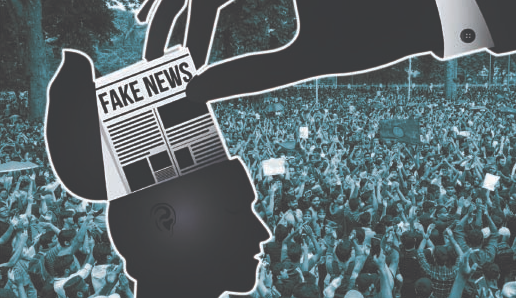
Until the collapse of the Hasina regime on August 5, 2024, a significant portion of Bangladesh’s mainstream media had aligned itself squarely against the people’s democratic aspirations. During the student upheaval of the July Revolution, they painted a grotesque picture of peaceful demonstrators, like millions of students and citizens alike, as unruly mobs, saboteurs, or foreign agents. Such deliberate mischaracterization was not just an editorial lapse but a strategic maneuver to delegitimize a mass uprising that had, by any international standard, exemplified the strength of nonviolent civil disobedience.
Even the most brutal autocracies often find at least some elements of the press willing to whisper dissent. In Bangladesh’s case, however, the opposite happened. In an unprecedented and disturbing inversion of democratic values, the national media stood hostile to its people. The problem is not a matter of casual misreporting or circumstantial bias; it is a calculated campaign of distortion and erasure. And though the swift fall of Sheikh Hasina’s fascist regime ultimately forced some retraction and revision, the deeper malady remains entrenched. A section of the Bangladeshi media continues to function less as a guardian of public interest and more as a proxy agent for foreign strategic narratives, particularly those aligned with India.
The Persistence of Pro-India Bias in a Post-Awami Political Landscape
Following the dramatic political realignment of August 2024, many news outlets were compelled by circumstance to distance themselves from the Awami League’s fallen authoritarian order. Yet, their editorial instincts have remained remarkably consistent and unmistakably tinted with residual loyalties. Most notably, there exists a curious and concerning persistence of Indian rhetorical frameworks in their content, often surfacing in how minority issues, communal tension, and border incidents are reported.
A glaring example unfolded on June 24, when Bangla Tribune published a story under the inflammatory headline that "devotees" had issued an ultimatum to demolish a Durga temple in the Khilkhet area of Dhaka. According to the report, a religious procession allegedly demanded the removal of the temple, warning it would be torn down if not dismantled by noon the following Tuesday. The article explicitly stated, “The devotees will demolish the temple.”
But this narrative was a complete inversion of reality. The core issue had nothing to do with communal fanaticism or temple destruction; rather, it revolved around an illegal land grab. The land in question belonged to Bangladesh Railway and was being claimed in the name of constructing a temple. A signboard bearing the name of a prominent BNP leader was erected to lend legitimacy to this illegal act. No temple had been built at the time of reporting. What the Bangla Tribune portrayed as a threat to minority rights was in fact a case of unlawful occupation of public land under religious pretense. Yet the damage had been done.
Indian Echo Chambers and Media Diplomacy
Within 24 hours of the Tribune’s report, the Indian Ministry of External Affairs capitalized on the misinformation. During a press briefing, its spokesperson referred to “extremists threatening to demolish a temple in Dhaka,” chastising the interim government for allegedly allowing such religious vandalism under the guise of “illegal land use.” It was an obvious and opportunistic weaponization of a fabricated incident, used to question Bangladesh’s treatment of minorities and the legitimacy of its transitional administration.
This was no isolated episode. The spread of such unverified, provocative content has become a pattern, with the Bangladeshi media effectively serving as a conduit for Indian strategic narratives. The net result is a media ecosystem that unwittingly or perhaps intentionally undermines Bangladesh’s sovereignty by offering fodder for Indian propaganda campaigns. It is an insidious form of journalistic subversion, where misinformation isn’t just a domestic issue but a geopolitical liability.
One cannot ignore the parallels between these actions and the coordinated disinformation strategies employed by so-called “Godi Media” in India—a term used to describe the compliant, government-aligned news channels that manufacture consent for authoritarianism under the guise of nationalism. In recent months, Bangladeshi media has displayed troubling signs of succumbing to a similar model, becoming an accomplice in regional information warfare rather than a neutral observer or fact-based informer.
The Bhavesh Incident: Anatomy of a Manufactured Outrage
Another case that underscores the danger of unverified media reporting was the alleged abduction and murder of Hindu leader Bhavesh in Dinajpur. Without any forensic or investigative verification, the Daily Star published the story as an act of communal violence. The timing was perfect for India’s media to amplify it: within hours, Indian outlets ran headlines portraying it as evidence of a systemic campaign against minorities under the new government led by Dr. Yunus. India’s Ministry of External Affairs followed suit, issuing a formal condemnation of what they called “another brutal example” of religious persecution.
However, the facts, once again, told a different story. Post-mortem and forensic reports showed no signs of violence, injury, or poisoning. There was no indication whatsoever that Bhavesh’s death was linked to his religious identity or political activism. Subsequent fact-checking revealed that a group of journalists had disseminated the initial story without proper verification, likely driven by a mixture of sensationalism and political motives.
Yet the damage was already done. The Yunus government, still stabilizing itself after months of unrest, was framed in international headlines as complicit in minority suppression. It is this reckless abandonment of journalistic ethics that raises serious concerns about the media’s ability or willingness to act as a responsible agent in national affairs.
Why the Obsession with Minority Narratives?
This pattern begs a larger question: Why is there such an insatiable appetite in Bangladeshi media to report, amplify, and often exaggerate stories about minority oppression, especially when they serve no purpose other than to invite foreign scrutiny and sow domestic discord?
There is no doubt that minority rights must be vigilantly protected in any democracy. But when the narrative is continuously skewed, manipulated, or weaponized to suit geopolitical agendas, the media ceases to function as a watchdog and instead becomes a destabilizing force. The obsession with creating news content that aligns with Indian strategic interests not only delegitimizes legitimate minority grievances but also exposes the nation to unnecessary diplomatic tensions.
This phenomenon of self-sabotaging reportage becomes even more glaring when juxtaposed against the silence over issues of far greater national consequence. Take, for instance, the case of 45 undocumented individuals, where 14 of them were Rohingyas, who were pushed across the border by India on June 28, through Jaintapur in Sylhet and Baralekha in Moulvibazar. Despite the magnitude of this cross-border violation, major newspapers chose not to highlight the story, neither on their front pages nor anywhere prominent.
Selective Silence and Manufactured Consent
On the very same day that Indian spokespersons falsely condemned the Khilkhet temple demolition, some of Bangladesh’s leading dailies, like Prothom Alo and The Daily Star, prioritized these diplomatic statements on their front pages—without clarifying the falsehoods embedded in the original reports. They subtly endorsed the Indian narrative by omission, allowing public perception to be shaped by unverified or misleading claims.
Ironically, these same media houses have demonstrated a pattern of publishing sensationalist or false news, only to retract it quietly after the damage has been done. A recent research paper presented by the Press Institute of Bangladesh (PIB) titled “The Nature of Recent Misinformation in the Media” ranks Prothom Alo as the worst offender in terms of frequency of retractions. Daily Star, though relatively less frequent, still ranks among the top five. Others in this ignoble list include Kalbela, Ittefaq, Dhaka Post, Bangla Tribune, and BD News. The paper found that many of these retracted stories were not just innocent errors but deliberate fabrications aimed at pushing political agendas or increasing revenue.
Notably, none of the media outlets involved in these lapses have been held accountable. No legal consequences, no regulatory oversight, and no internal investigations have followed. This impunity has bred an environment where falsified reports are not exceptions but operational norms.
Normalizing the Fallen Regime: Rehabilitation of the Awami League
More troubling still is the role some media houses are playing in sanitizing the record of the Awami League, even after its catastrophic fall. Opinion pieces and analysis columns increasingly advocate for the return of the party to the electoral fold. Eminent figures such as Dr. Rehman Sobhan have written about the dangers of excluding the Awami League from future elections. Articles by foreign commentators like David Bergman echo the same sentiment, glossing over the party’s dark legacy of enforced disappearances, secret prisons, and extrajudicial killings.
This effort to “rehabilitate” a regime responsible for decades of democratic decay and state terror appears less like journalistic impartiality and more like historical revisionism. If crimes of this magnitude are excused in the name of political stability or reconciliation, the very foundations of the Republic will be hollowed out.
A Call for Accountability in the Era of Rebirth
Bangladesh is at a critical juncture. The July Revolution did not merely overthrow a regime; it offered a blueprint for a different kind of politics—one anchored in transparency, democratic participation, and civic dignity. But this fragile hope can easily be sabotaged from within, especially by a media apparatus still shackled by old loyalties and external dependencies.
India’s continued attempts to delegitimize the new government, whether through false temple demolition stories, invented murders, or diplomatic fear-mongering, are made easier by a compliant media class inside Bangladesh. And as long as this class faces no reckoning, the nation’s political and informational sovereignty will remain compromised.
To ensure that Bangladesh's hard-won freedom is not eroded from within, a national conversation on media accountability must begin. There must be independent mechanisms to verify claims before publication, penalties for intentional disinformation, and institutional safeguards to prevent foreign interests from manipulating domestic narratives.
This is not simply a matter of media ethics. It is a matter of national survival. The July Revolution was an unparalleled moment in South Asian history. On August 5, an extensive number of people took to the streets of Dhaka in an oceanic uprising against tyranny. And yet, a neighboring nation with the world’s largest population dismisses this democratic renaissance. Whether this ignorance is feigned or real, it betrays the inability of entrenched elites to comprehend people’s power when it emerges from beyond their control. The revolution’s true legacy will be determined not just by who governs but by who tells the story and how.