

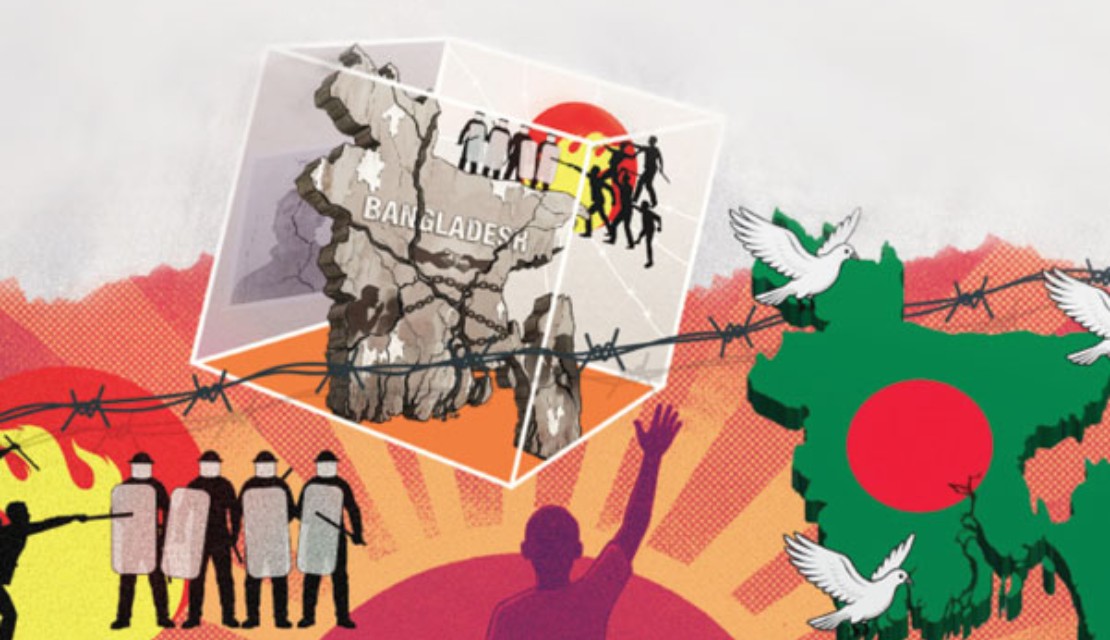
The most sacred pillar of any democratic state is the absolute, uncompromising guarantee of a citizen’s right to exist. It is the bedrock of the social contract: the populace surrenders certain absolute liberties in exchange for the state’s protection of life, property, and the rule of law. Yet, when the state apparatus quietly morphs into an apex predator, the social contract does not fracture; it disintegrates. For over a decade and a half, Bangladesh did not just witness a decline in democratic norms; it endured the systematic institutionalization of state-sponsored terror. Enforced disappearance became the definitive weapon of political coercion during the recently ousted Awami League administration led by Sheikh Hasina.
What began as isolated incidents of authoritarian overreach gradually hardened into a monstrous bureaucratic machine. The state engineered a culture of profound coercion, transforming the government into a fascist entity that operated primarily in the shadows. For anyone who dared to articulate a dissenting thought, the risk of vanishing without a trace became a paralyzing reality.
Today, the geopolitical community and the citizens of Bangladesh possess overwhelming, undeniable evidence detailing how various intelligence factions and law enforcement syndicates operated as death squads and abduction rings between January 2009 and August 2024. But the tragedy of Bangladesh’s current political reality is not just rooted in its past. Despite the euphoric aspirations for structural state reconstruction following the historic, blood-soaked mass uprising of students and civilians in July and August 2024, the ghost of impunity refuses to die. The specter of enforced disappearances has returned, deeply terrifying a conscientious nation that believed it had finally severed the head of the snake.
The Sociology of a State Crime
To understand the mechanics of Sheikh Hasina’s regime, one must look beyond mere political science and delve into the sociology of fear. An enforced disappearance is never just about the individual who vanishes. It is a highly engineered form of enduring "psychological terror" inflicted upon the entire sociopolitical fabric. Noting that when a state systematizes enforced disappearances, it deliberately plants a culture of chronic fear deep within the societal psyche. This invisible terror paralyzes freedom of thought, ruthlessly stifles grassroots civic protest, and systematically extinguishes the public’s courage to demand fundamental constitutional rights.
This psychological paralysis can be further understood through the diagnoses of the internal rot of the Bangladeshi state. When the very law enforcement agencies sworn to protect citizens begin violating the law by dragging people into unmarked vans, and when the judiciary and state executives grant absolute impunity to these perpetrators, public trust evaporates entirely. The law ceases to be a shield and becomes a weapon. This breeds severe social instability and a terminal distrust in state institutions. Such actions not as just a political corruption, but as heinous "state crimes." When the state itself becomes the primary criminal syndicate, the resulting culture of impunity infects every pore of civil society, normalizing the abnormal and justifying the horrific.
Dissecting the Shadows: The Statistical Reality of Erasure
The full, horrifying scale of this state crime was recently laid bare by the "Commission of Inquiry on Enforced Disappearances." Led by Justice Mainul Islam Chowdhury, the commission produced a historic, unflinching diagnostic document titled, “Unfolding the Truth: A Structural Diagnosis of Enforced Disappearance in Bangladesh.” The report is a masterclass in uncovering systemic atrocities, revealing that during Hasina’s fifteen-year reign of terror, the total number of disappeared citizens eclipsed a staggering 6,000.

The Demographics of Vanishing
(Analysis of the 61% of victims with direct political affiliations)Prior to this deep state audit, brave local human rights organizations like Odhikar had conservatively estimated over 600 incidents. However, once investigators breached the highly classified state archives, physically inspected subterranean secret detention facilities, and recorded harrowing testimonies from shattered families, the true, catastrophic scale emerged.
Out of 1,913 formally submitted written complaints that underwent a rigorous, uncompromising vetting protocol, 1,569 incidents were conclusively verified as direct, state-sponsored "enforced disappearances" under strict international legal standards. The grim ledger includes concrete, irrefutable evidence of the extrajudicial killings of at least 287 victims, while another 251 individuals remain permanently lost to the void.
While activists from Jamaat-e-Islami and Bangladesh Islami Chhatrashibir constituted the vast numerical majority of those abducted, a darker reality emerges when analyzing the permanent casualties. When it comes to the 287 killed and the 251 permanently missing, leaders and grassroots organizers of the Bangladesh Nationalist Party (BNP) suffered disproportionately, accounting for a staggering 68% of these permanent losses. The disappearances of high-profile figures of BNP leaders remain gaping wounds in the nation's political history, subjecting their families to a decade and a half of agonizing uncertainty.
Enforced Disappearances by Selected Years
● 2013: 128 Victims – Pre-election purge
● 2014: 95 Victims – Fraudulent one-sided election
● 2016: 215 Victims – Crackdown on dissent
● 2017: 194 Victims – Sustained suppression
● 2018: 192 Victims – Election year silencing

The Architects of the Void
The machinery required to vanish thousands of people does not operate spontaneously; it requires a highly coordinated, well-funded bureaucracy of death. The commission's findings conclusively proved the direct, operational involvement of the nation's elite security apparatus: the Rapid Action Battalion (RAB), the Directorate General of Forces Intelligence (DGFI), the Detective Branch (DB) of the police, and the Counter Terrorism and Transnational Crime (CTTC) unit.
These agencies maintained a clandestine network of black sites. The most notorious among them, operated jointly by the intelligence wings of the DGFI and RAB, became known in the public lexicon as Aynaghor. Inside these soundproofed subterranean cells, citizens were subjected to unspeakable psychological and physical torture, held entirely outside the judicial system for years on end.
The fall of Sheikh Hasina’s regime cracked open the doors of these black sites. The re-emergence of prominent figures including Supreme Court lawyer Barrister Ahmad Bin Quasem (Arman), illegally dismissed Brigadier General Abdullahil Aman Azmi, and former Denmark-based ambassador Maruf Zaman shocked the global conscience. Emerging from the blinding darkness of Aynaghar after enduring eight to nine years of absolute isolation, their emaciated survival stands as a damning testament to a ruthless, state-sponsored conspiracy designed to biologically and socially erase free citizens.
In other instances, the regime outsourced its repression across borders. Individuals were extrajudicially trafficked into neighboring India, bypassing all known immigration and legal frameworks. The terrifying cases of BNP Standing Committee member Salahuddin Ahmed found mysteriously abandoned in an Indian border town and Sukharanjan Bali, a key defense witness abducted from the gates of the war crimes tribunal for Jamaat leader Allama Delwar Hossain Sayeedi, illustrate a transnational disregard for sovereignty and law.
The False Dawn and the Legal Illusions of 2024
One might logically assume that the spectacular, bloody collapse of the Awami League regime in August 2024 would trigger a total dismantling of this sinister infrastructure. Yet, the brutal reality of transitional politics is often defined by the quiet preservation of power. The newly installed interim administration’s failure to rapidly enact permanent, concrete legal reforms is actively extending the lifespan of the culture of impunity.
Crucial ordinances drafted during the chaotic interim period, specifically those aimed at the uncompromising prevention of enforced disappearances and the empowerment of the National Human Rights Commission were cynically allowed to lapse. Instead of being cemented into permanent, binding law by the legislature, they dissolved into bureaucratic ether.
The consequences of this legislative negligence are devastating. The deeply controversial legal provision requiring prior government authorization before initiating investigations or legal proceedings against security forces remains fully active. This effectively functions as a legal shield for murderers in uniform.
A coalition of heavy-hitting watchdogs including Transparency International Bangladesh (TIB), Odhikar, and the Bangladesh Legal Aid and Services Trust (BLAST) have sounded the alarm over the heavily diluted, newly approved draft of the “Enforced Disappearance Prevention and Redress Act.” By intentionally retaining clauses that mandate prior governmental permission to prosecute, the draft law ensures that the deep state protects its own. Furthermore, deciding to entrust the investigation of these severe crimes against humanity to the standard police force is a monumental conflict of interest. It fatally undermines the independent institutional jurisdiction of the Human Rights Commission, practically guaranteeing that investigations will be compromised by the very agencies implicated in the crimes.
The Ghost of the Present: The Miraj Sheikh Tragedy
The ultimate victim of this compromised, hollow legal framework is, as always, the ordinary citizen. If anyone believed that the revolution of '24 had permanently closed the door on extrajudicial abductions, the chilling case of Miraj Sheikh shatters that illusion completely.
On April 10, in the remote, impoverished Jaymoni area of Mongla in Bagerhat, a 30-year-old fisherman and part-time motorcycle driver named Miraj Sheikh became the newest victim of the deep state. According to terrified eyewitnesses and devastated family members, an operative squad dressed in civilian plainclothes, accompanied by uniformed members of the Bangladesh Coast Guard, descended upon Miraj. He was forcibly dragged to the Jaymoni pontoon and rapidly transported via a high-speed military boat to the Harbaria camp.
The international community has reacted with profound alarm. Human Rights Watch (HRW) unequivocally categorized the incident as Bangladesh’s “first enforced disappearance” of the post-uprising era. The mechanics of the abduction mirror the darkest days of the Hasina regime. Miraj's wife, Mukta Khanam, recounted how the operatives forced her husband into a room with blacked-out, dark-tinted windows before whisking him away. The subsequent state cover-up was clumsy but terrifyingly familiar. A local Coast Guard official initially admitted via a recorded phone call that Miraj was detained for "questioning," only for the higher command to swiftly issue a total, absolute denial of the entire operation.
The cruelty inflicted upon Miraj’s family highlights the unbroken continuity of state malice. When his desperate family sought answers, they were not met with justice; they were met with the full, punitive wrath of the state. Miraj’s wife, his elderly mother, and his sister, Liza Islam, were brutally arrested on completely fabricated charges of "terrorism and sabotage" and thrown into jail for 27 days. This is the classic playbook of authoritarianism: silence the victim by destroying their family.
Despite the Coast Guard's Mongla West Zone dismissing the abduction as a coordinated "smear campaign," the physical evidence is undeniable. During the abduction, the operatives left Miraj’s motorcycle at a local shop. Eleven days later, at 4:00 AM under the cover of darkness, individuals identifying themselves as Coast Guard personnel returned to retrieve the vehicle using the exact key that Miraj had in his pocket when he was abducted. Furthermore, the authorities have deliberately blocked access to the geolocation tracking data of Miraj’s two mobile phones, data that could instantly unravel the state's
web of lies.
Human rights activist Nur Khan Liton, speaking at a highly charged press conference at the National Press Club on August 24, pointed out the blatant legal violations. Under the newly amended 2026 Code of Criminal Procedure, arresting officers are legally bound to strictly disclose their identity, specify the exact grounds for arrest, and immediately inform the family of the detainee's location. Every single one of these statutory provisions was flagrantly, almost mockingly, violated in Bagerhat.
Following a desperate writ petition, the High Court issued an ultimatum, ordering state authorities to locate the impoverished fisherman and produce him in court within 15 working days. Meenakshi Ganguly, Deputy Director of HRW’s Asia Division, seized upon this moment to issue a blistering critique of the transitional government. “Thousands of people fell victim to enforced disappearances during Sheikh Hasina’s 15-year rule.
This latest incident proves that without genuine reform, such events could recur," Ganguly stated. She rightly diagnosed the structural rot, noting that these extrajudicial practices are "deeply entrenched within Bangladesh’s security agencies." Ganguly’s demand is clear: the government must strip the police of their investigatory monopoly, eliminate all executive interference, and fully restore the Human Rights Commission’s authority to hunt down the architects of disappearances.
The Unfinished Revolution
The agonizing, unanswered pleas of an innocent child, an ailing elderly father, a traumatized wife, and a persecuted sister in Bagerhat have placed a massive, inescapable question mark over the soul of the new Bangladesh. The fundamental mandate of a state's security apparatus is to shield its vulnerable, not to hunt them under the cover of night. If a citizen is suspected of a crime, they must face the rigorous, transparent light of the judicial process. Abductions executed in the shadows are not law enforcement; they are cowardly acts of state terrorism.
To genuinely transform Bangladesh into a resilient, healthy democratic republic permanently insulated from the creeping rot of fascism, this horrific, normalized culture of enforced disappearance must be eradicated at its very roots. It is not enough to change the political leadership while leaving the architecture of state terror perfectly intact. All legislative loopholes offering executive immunity must be violently torn from the law books. Miraj Sheikh must be returned immediately in strict accordance with the High Court’s unyielding directives. More broadly, the National Human Rights Commission must be unshackled and granted absolute, unhindered investigatory supremacy over the military and police forces. Until the deep-seated culture of impunity is annihilated, the blood spilled on the streets of Dhaka during the revolution of '24 will have been in vain. A revolution that only changes the faces of the abductors is no revolution at all; the core spirit of freedom will remain nothing more than a tragic, elusive mirage.