

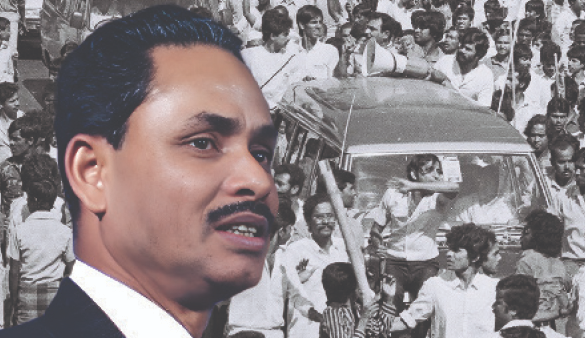
On 6 December 1990, Bangladesh watched something rare in South Asian political history: an entrenched military ruler, H. M. Ershad, stepped down under the force of a mass uprising. That moment still carries mythic power because it wasn’t a party victory—it was a civic victory. Students, professionals, and an opposition alliance that included the Awami League (AL), Bangladesh Nationalist Party (BNP), Bangladesh Jamaat-e-Islami and other political parties converged on one demand: restore elections, restore accountability, restore the people’s voice. The uprising created a moral benchmark for what democratic legitimacy should look like in Bangladesh: mass consent, not administrative control.
1991: A democratic reset—then the rivalry returns
The transition that followed was unusually credible. A neutral arrangement led to the 27 February 1991 election—still remembered as a high point of electoral confidence—after which Khaleda Zia became Prime Minister. The BNP government then oversaw the Twelfth Amendment (1991), restoring the parliamentary system and curbing the hyper-presidential model associated with prior authoritarian periods. In any honest democratic history, this deserves acknowledgment: the institutional frame mattered. But almost immediately, a fatal pattern emerged. Bangladesh’s political actors treated democracy not as a shared system, but as a battlefield—where losing power meant losing safety, access, and future relevance. That mentality turned parliament into a staging ground for paralysis rather than deliberation.
BNP’s first tenure (1991–1996): Democratic architecture, confrontational habits
By the mid-1990s, the Awami League and other opposition forces intensified demands for an election-time neutral government. The BNP resisted. The dispute wasn’t just procedural; it was existential. In a low-trust political culture, whoever controls the election machinery is assumed to control the outcome. The crisis reached its peak with the 15 February 1996 election—boycotted by major opposition parties and widely viewed as lacking legitimacy. The BNP’s win became politically meaningless. Under pressure, parliament passed the Thirteenth Amendment establishing the caretaker government system on 25 March 1996. Khaleda Zia resigned on 30 March 1996, and a caretaker administration led by former Chief Justice Muhammad Habibur Rahman prepared the ground for a new election. Then came the pivotal “proof-of-concept”: the 12 June 1996 election under the caretaker model brought the Awami League to power, with strong turnout and broad acceptance of the result. Bangladesh had, in effect, invented a mechanism to compensate for the absence of trust. For a while, it worked.
Awami League (1996–2001): Negotiated reforms amid polarization and violence
The Awami League’s 1996–2001 tenure is frequently noted for significant political settlements that illustrated the capacity of democratic governments to resolve long-standing disputes through negotiation. Two major agreements defined this period: the Ganges Water Sharing Treaty, signed on 12 December 1996, which established a framework for managing a critical bilateral issue with India, and the Chittagong Hill Tracts Peace Accord of 2 December 1997, which ended a decades-long insurgency through political accommodation. Both agreements, however, were concluded without the support of the principal opposition parties. The BNP and Jamaat-e-Islami remained openly skeptical, questioning the transparency, inclusiveness, and political motivations behind these negotiations. As a result, these achievements failed to generate cross-party legitimacy.
Moreover, this period was overshadowed by persistent political violence, including activities widely attributed to the Awami League’s student wing and affiliated organizations. Such violence further eroded public trust and reinforced a climate of polarization. While the government demonstrated the potential of democratic negotiation, Bangladesh continued to suffer from a deeper structural weakness: mutual delegitimization. Each major party increasingly treated the other’s rule as inherently unlawful, ensuring that governance successes remained politically fragile and that transitions of power continued to carry the risk of instability.
2001: The BNP returns—now with Jamaat as a central partner
The 1 October 2001 election returned the BNP to power in a sweeping victory. Jamaat-e-Islami, as part of the BNP-led alliance, significantly expanded its parliamentary presence.
This BNP–Jamaat era hardened ideological fault lines. For supporters, it represented democratic inclusion and coalition legitimacy. For critics, it normalized a political force seen as opposed to secular nationalism and morally compromised by the unresolved history of 1971. Here lies one of Bangladesh’s most difficult democratic puzzles: What does pluralism mean in a state founded on a particular historical memory? If democracy is only about elections, then exclusion is always suspect. But if democracy is also about constitutional identity and historical accountability, then inclusion without reckoning becomes equally suspect. Jamaat’s role repeatedly forced Bangladesh to confront that unresolved contradiction.
2004–2006: Violence and distrust poison the system
Polarization wasn’t only rhetorical. It often turned lethal. The 21 August 2004 grenade attack at an Awami League rally in Dhaka killed 24 and injured hundreds, deepening fear, anger, and conspiracy on all sides. Whether one reads such episodes primarily through criminal justice or political rivalry, the political consequence was the same: a democracy that no longer felt safe for losers—or sometimes even for winners. As the BNP term approached its end, disputes over the caretaker process escalated. The country slid into confrontation that institutions could not absorb.
“1/11” (11 January 2007): When deadlock invites extra-constitutional power
Bangladesh’s political crisis culminated in the 11 January 2007 intervention—popularly remembered as “1/11”—when emergency measures and military backing reshaped the caretaker arrangement.
Fakhruddin Ahmed became Chief Adviser on 12 January 2007, leading a caretaker government that lasted beyond the constitution’s intended short timeframe. This period exposed a recurring vulnerability: when parties refuse compromise, non-democratic actors gain room to “restore order.”
2008: Democracy returns—without fixing the root problem
Elections were eventually held, and the caretaker administration handed over power on 6 January 2009 after the 29 December 2008 vote. But Bangladesh had not solved the root issue. It had merely repeated its cycle: protest → election → rivalry → deadlock → institutional strain → exceptional measures → election again.
Mutual Legitimacy (2009–2025): From competitive politics to a fascist-type regime
Following its return to power in 2009, the Awami League presided over an extended period of political continuity marked by extreme centralization of authority and the erosion of democratic competition. While elections continued formally, the underlying conditions necessary for democracy—pluralism, electoral uncertainty, and meaningful opposition—progressively disappeared.
The abolition of the caretaker government system eliminated the last broadly accepted mechanism for electoral neutrality. Subsequent elections were widely contested in terms of credibility, with allegations of vote manipulation, administrative capture, and voter disenfranchisement. In practical terms, citizens were deprived of the effective right to choose their representatives. This period exhibits defining characteristics of a fascist-type regime: fusion of party and state, systematic repression of opposition, use of coercive apparatuses to silence dissent (including enforced disappearances and intimidation), instrumentalization of the judiciary for political consolidation, and large-scale corruption rationalized through nationalist rhetoric and mega-development projects. Political power ceased to be contested and instead became entrenched.
Opposition parties, faced structural exclusion—participation legitimized a non-competitive system, while non-participation resulted in political marginalization. The narrowing of pluralism, including the effective elimination of Jamaat-e-Islami from formal politics, did not reduce polarization but reinforced dominant-party authoritarianism. By this stage, Bangladesh no longer functioned as an electoral democracy. Governance persisted, institutions operated, and stability was maintained—but democratic rule had been displaced by a durable, authoritarian, and fascist-style political order.
July 2024: The uprising that reframed the legitimacy question
Then came the July 2024 student-led uprising, initially triggered by the job quota controversy. After a High Court decision (reported widely at the time), protests surged nationwide. Amnesty International noted that amid violence and heavy restrictions, Bangladesh’s Supreme Court ordered a reduction of the quota—described as from 30% to 5%—on 21 July 2024.
What distinguished this moment was not only the scale, but the symbolism: a new generation was publicly challenging the political settlement that had governed their entire adult lives. It echoed 1990 in moral energy—yet differed in structure. This was not simply a party-led movement. It was, at its core, a legitimacy revolt. International reporting later described the turmoil as a crisis that ultimately ended Sheikh Hasina’s long rule, with Reuters referring to an uprising that forced her to flee and led to an interim government under Nobel laureate Muhammad Yunus.
The aftermath: justice, due process, and the danger of “victor’s morality”
After such upheaval, societies often demand justice—and Bangladesh was no exception. But justice can rebuild democracy, or it can become a substitute for democracy. AP reported that Bangladesh’s International Crimes Tribunal sentenced Sheikh Hasina and a former minister to death in absentia related to a violent crackdown on the 2024 protests, while human rights groups raised due process concerns. Reuters also reported that Bangladesh’s interim authorities later banned Awami League activities under the Anti Terrorism Act pending legal proceedings, a move the Awami League rejected as illegitimate. This is Bangladesh’s recurring test: Can accountability be delivered in a way that strengthens rule of law rather than weaponizes it? If due process is weak, even morally popular punishment can corrode democratic foundations. If accountability is absent, impunity corrodes them too.
Reform proposals: A chance to rebuild the rules of losing
Reuters reported that the interim government planned a referendum on a proposed “July Charter” of reforms, including constitutional and institutional changes, to be held alongside elections.
Whether one supports the charter or fears it, the democratic question is bigger: can Bangladesh finally craft a political compact that makes elections credible and makes power limited?
Where BNP, AL, and Jamaat fit in the “new” moment
• Awami League faces an existential legitimacy crisis after the uprising and subsequent state actions against it. If it is to re-enter democratic competition credibly, it will need a politics that can accept checks and constraints—not simply return to dominance.
• BNP may see opportunity, but opportunity is not the same as democratic leadership. If the BNP returns to power without institutional restraint, Bangladesh risks recreating the old cycle in new colors.
• Jamaat and other Islamist forces remain part of Bangladesh’s political reality, whether through formal participation or street influence. The democratic challenge is to define lawful political inclusion without surrendering constitutional rights, minority protections, or historical accountability.
Conclusion: The real choice is not “who rules,” but “how rule is limited”
Bangladesh’s democratic story since 1990 shows a painful pattern: democratic legitimacy is repeatedly born on the streets, then suffocated inside institutions that parties refuse to share. 1990 taught that unity can remove authoritarianism. 1996 showed that neutral mechanisms can rebuild trust—temporarily. 2007 proved that deadlock can invite undemocratic control. July 2024 revealed that a new generation will not accept a democracy that only performs elections without protecting voice, fairness, and accountability. If Bangladesh is to escape its historical loop, it must finally institutionalize what its parties have avoided for decades: a shared commitment to the legitimacy of losing—because only then can winning stop being absolute, and democracy stop being existential.