

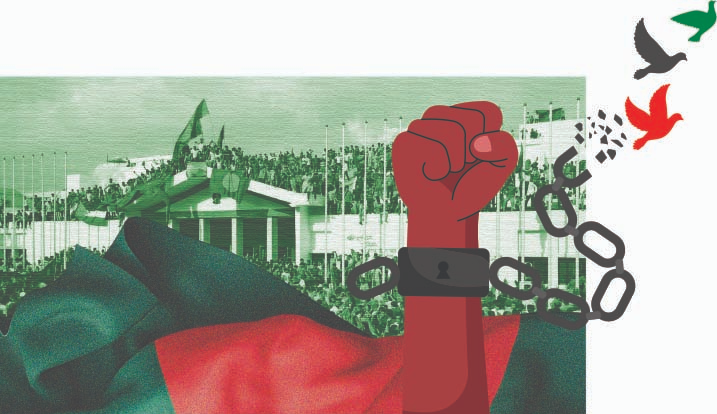
On the dawn of August 5, 2024, Bangladesh awakened to what many now call its "second independence." Unlike the armed liberation war of 1971, this new emancipation was neither declared by a provisional government in exile nor achieved through conventional warfare. It rose from the rage of classrooms, the pain of parents, and the courage of adolescents. It was not led by generals or party elites, but by children, teenagers, and university students—those who had been denied their future in a state increasingly defined by autocracy, nepotism, and fear.
A year has passed since that tumultuous July-August uprising—an uprising that ended the 15-year authoritarian rule of Sheikh Hasina, brought down one of Asia’s most enduring dynastic regimes, and redefined the political grammar of South Asia. As the world commemorates this historic transformation, the memory of what led to it and what emerged from its bloodied path remains both cautionary and revolutionary.
From Frustration to Fire: The Spark of Rebellion
For years, Bangladesh simmered under a heavy, suffocating silence. What began as democratic consolidation after the turbulent years of military-backed caretaker governments morphed into an unchecked concentration of power under the Awami League and Sheikh Hasina. Elections became rituals. Opposition leaders disappeared or were imprisoned. Journalism became a perilous act. Dissent was crushed under the weight of surveillance, lawsuits, and brute force.
But nations do not remain silent forever.
The spark came not from political parties but from students. What started as an anti-quota protest—a demand to dismantle a deeply unpopular system that reserved significant portions of government jobs for the children of bureaucrats and freedom fighters—quickly morphed into a mass rebellion against a decaying regime. It was, on its face, a policy protest. But in essence, it was the nation’s youth rejecting inherited injustice.
Their slogan was simple but thunderous: “Quota prothar kobor de.” That chant soon gave way to deeper, more defiant calls: for justice, for democracy, and for an end to a dictatorship that had overstayed its welcome by decades.
The Children Who Fought
This was not an ordinary uprising. Unlike 1990, when students brought down General Ershad, or 1969’s anti-Pakistan agitation, the July 2024 movement saw a new demographic in the vanguard: children. At least 132 minors were killed during the July uprising. Seven-year-olds, disabled adolescents, teenage girls, and schoolchildren in uniforms marched alongside university students, teachers, and workers. Some died holding placards. Others died shielding their siblings from bullets.
One 17-year-old, Anas, left behind a letter that would echo around the country and beyond. “Mother, I am going to the procession. I could not restrain myself any longer. Our brothers are dying for us. If I die, be proud, not sad,” he wrote. In that simple note, Anas captured the moral urgency of the revolution: that death was preferable to living under the boots of tyranny.
Even the United Nations Human Rights Commission, typically cautious in its assessments, released harrowing details of state repression. In one case, a wounded teenager was prevented from entering a hospital by police, who allegedly ordered his body to be dumped in a drain. He died soon after. These were not isolated acts of brutality; they were systemic, sanctioned, and deliberate.
Hasina’s security forces, once considered instruments of law and order, became symbols of barbarism. From the skies, helicopters rained bullets on protesters. On the ground, snipers targeted the eyes of demonstrators, leaving more than 600—many of them minors—permanently blinded. The strategy was not just suppression; it was psychological warfare.
Schools as Barricades, Classrooms as Memorials
By the end of July, schools across the country no longer resembled learning spaces. They became murals of resistance. Graffiti caricatured Sheikh Hasina as a vampire. Blackboards displayed poetry written in blood. Playgrounds turned into makeshift memorials.
One graffiti in Dhaka read: “Buk petesi guli kor.” It captured the mood of a generation raised under surveillance, lied to in textbooks, and treated as pawns in political theater. This was a generation taught to worship a mythical version of the liberation war where the Sheikh family were divine figures, Mujib a saint, and Hasina the appointed redeemer. However, the youth recognized the absurdity. They reclaimed their history and rewrote it, one wall at a time.
They also rejected the regime’s cult of personality. The chant, “Who are you, who am I? Rajakar, Rajakar!” turned against the very party that had weaponized history to silence dissent. It was the ultimate irony: the same history used to entrench autocracy became the tool to tear it down.
The Fall of a Dynasty
On August 5, the regime collapsed under the weight of its contradictions. Cracks within the military, diplomatic pressure, and the sheer scale of public resistance made Hasina’s position untenable. The once-unchallenged prime minister fled into exile; her departure was marked not by ceremony but by silence.
Two days later, France’s La Mode published a headline that reverberated across global media: “Bangladesh: The Fall of a Dynasty.” The article drew stark comparisons between Hasina and her father, Sheikh Mujibur Rahman, who was once revered as the architect of independence but later criticized for imposing a one-party state in 1975. The parallels were uncomfortable but undeniable: centralization of power, suppression of opposition, and dynastic entitlement.
Protesters toppled statues of Mujib erected during Hasina's reign. The myth of the royal family as the custodians of Bangladesh’s destiny was shattered. What began as a rebellion against quotas had become a revolt against dynastic politics, authoritarian legacy, and manufactured patriotism.
Unmasking the Fascist Playbook
As the regime crumbled, it sought to defend itself with a familiar narrative: development. Hasina’s supporters claimed that under her rule, Bangladesh had achieved unparalleled economic growth, infrastructure expansion, and digital transformation. But this argument, too, crumbled under scrutiny. Fascist regimes throughout history have made similar claims, from Mussolini’s trains to Ayub Khan’s “Decade of Development.” But tyranny wrapped in economic metrics remains tyranny. No skyscraper, no metro line, and no export record can justify mass killings, censorship, and state terror.
The world has seen such oppression before. In Hitler’s Germany, in Salazar’s Portugal, and in Marcos’s Philippines, development was always used as a shield for authoritarian excesses. Bangladesh under Hasina was no different.
A Warning in Unity
Perhaps the most striking feature of the July uprising was its unity. The movement brought together people from all religious, political, and social backgrounds. It erased the lines drawn by years of manufactured hatred between Islamists and secularists, between left and right, and between Bengali nationalists and ethnic minorities. Parents brought their children to the streets. Women marched at the frontlines. Even garment workers, long silenced by fear of job loss, joined the protests. In that unity lay the regime’s defeat. But it also exposed a darker truth: the uncanny ability of Bangladesh’s political elites to coalesce when their shared privileges are threatened.
After Hasina’s fall, whispers of counter-revolution began to surface. Old rivals began forging new alliances. Media narratives shifted suspiciously fast, presenting the fallen regime as a victim of “foreign conspiracy.” Social media trolls resurfaced, now rebranding massacres as “necessary force.” It became evident that while the dictator had fallen, the dictatorship’s ecosystem was far from dismantled.
The Lessons of the Wall
The writings on the wall—both literal and metaphorical—must not be forgotten. They are the nation’s conscience etched in spray paint, blood, and ash. They reveal what the youth demand: not just new rulers, but a new political culture. One rooted in dignity, freedom, and accountability.
It is now the duty of those who will shape Bangladesh’s future to read those walls and listen to the language of its youngest citizens. They must ensure that the revolution is not stolen in the name of stability. That the blood spilled is not diluted by the ink of political compromise. That the dreams of Anas and thousands like him are not hijacked by another cycle of elite manipulation.
One Year Later: A Fragile Hope
As Bangladesh marks one year since its second independence, the country stands at a crossroads. The families of the fallen are still grieving. The injured are still in recovery. But a new generation is rebuilding, reimagining, and reclaiming the country their parents were too afraid to dream of.
The revolution of 2024 was not just about tearing down a regime. It was about challenging the very foundation of postcolonial South Asian governance: dynastic politics, authoritarian populism, and fake nationalism. It has shown the region and the world that even in the face of brutal repression, the power of unarmed youth can be more formidable than the most sophisticated state machinery. And yet, revolutions do not end with the fall of a dictator. They continue in classrooms, in parliaments, in courtrooms, and in memories. Whether Bangladesh moves forward into a more inclusive, democratic future or slips back into oligarchic authoritarianism will depend not only on its politicians but also on the people who dared to dream in July.
If those dreams are betrayed, a more powerful uprising will surely follow. And this time, it will not just ask for freedom; it will demand transformation.