

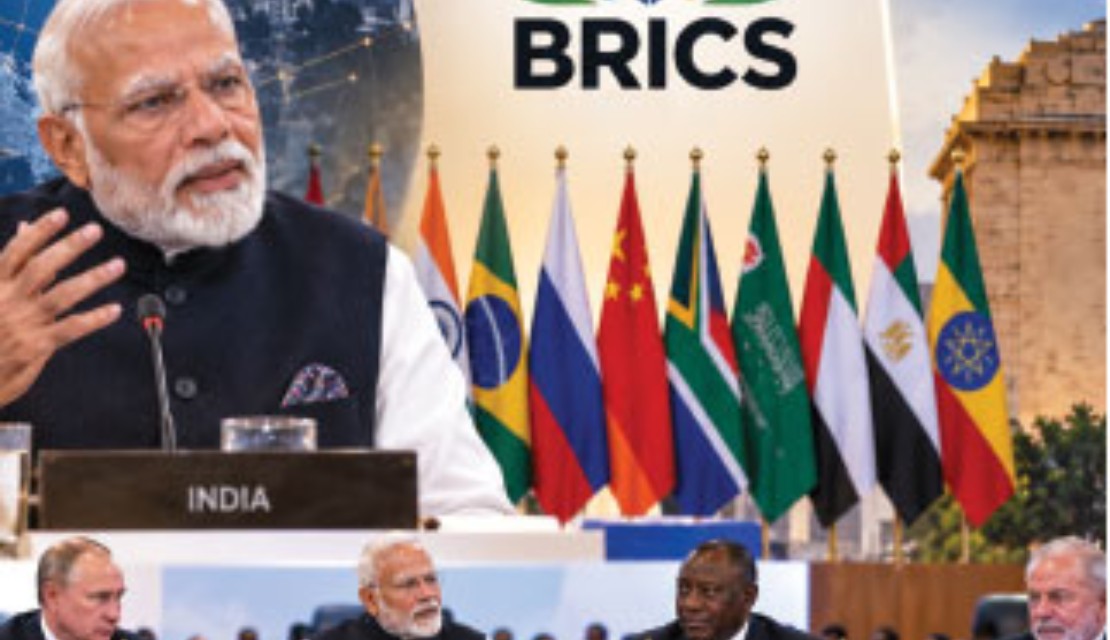
The recent eighteenth BRICS Summit, convened in the Indian capital of New Delhi on September 13 in the Outreach/Plus format, was a quintessential display of this diplomatic paradox. Drawing leaders from thirty-eight nations including geopolitical heavyweights like China, Russia, Brazil, and the host nation, India aimed to project a unified front capable of managing global crises. Since its inception in 2006, this coalition has evolved into an eleven-member behemoth, incorporating South Africa, Indonesia, Iran, Ethiopia, Egypt, Saudi Arabia, and the United Arab Emirates. Collectively, this bloc commands nearly half the planetary population and a formidable slice of the global economic output. Ostensibly, it stands as the vanguard of a new multipolar reality, a direct institutional challenger to the waning dominance of Western hegemony. Yet, beneath the polished veneer of consensus, the architecture of this alternative world order is remarkably fragile.
To dissect the true efficacy of this coalition, one must interrogate its internal contradictions. The foundational flaw of this multilateral platform is the illusion of alliance. These nations are not bound by shared political ideologies or cohesive strategic visions; rather, they are often locked in fierce, existential competitions. Consider the African continent, where diplomatic relations between Addis Ababa and Cairo have deteriorated into deep-seated animosity. The catalyst is the Grand Ethiopian Renaissance Dam. Ethiopia views the unilateral filling of this colossal infrastructure project as a non-negotiable imperative for its economic modernization. Conversely, Egypt perceives the exact same infrastructure as a catastrophic threat to its downstream water security, transforming a developmental initiative into a potential trigger for conflict. Similarly, the Middle Eastern contingent of the bloc is riddled with explosive hostilities. Iran sits at the same table as Saudi Arabia and the United Arab Emirates, despite a recent history marked by direct confrontation and proxy warfare. While Tehran remains locked in a shadow war with Western and Israeli interests, Abu Dhabi has cultivated close strategic ties with Tel Aviv, placing these ostensibly allied member states on violently opposing fronts.
The geopolitical friction extends into the high altitudes of the Himalayas, where the fierce rivalry between Beijing and New Delhi shatters any pretense of Asian solidarity. The bloody border skirmishes of 2020 remain a fresh wound, underscoring the volatile reality of their proximity. Furthermore, their global alignments are diametrically opposed. China operates as the primary systemic adversary to the American-led order, aggressively expanding its influence through vast infrastructure networks like the Belt and Road Initiative to court European markets. In stark contrast, India has meticulously positioned itself as a strategic linchpin and a trusted ally of the West. This divergence is compounded by Moscow’s presence. While Beijing actively seeks economic integration with Western Europe, Russia remains deeply entangled in a grinding conflict in Ukraine, enduring years of crippling economic sanctions imposed by the very European capitals China wishes to court. These nations do not merely inhabit different continents; they inhabit entirely different strategic universes, each pursuing national priorities that actively cannibalize the interests of their supposed partners.
The Alliance Contradiction Plot
Axis X represents Global Alignment; Axis Y represents Internal Hostility.

The profound lack of a shared vision for a future global order makes substantive decision-making an agonizing ordeal. The tension was palpable throughout the New Delhi proceedings. Factions within the bloc, notably China, Russia, Iran, and Brazil, view the consortium explicitly as a battering ram against Western influence. The host nation, however, fundamentally rejects this posture. The Indian leadership, determined to safeguard its lucrative Western partnerships, staunchly refused to let the summit devolve into an anti-Western echo chamber. The resulting New Delhi Declaration was heralded as a diplomatic triumph merely because producing any joint statement in such a polarized environment is a logistical miracle. The document championed the expansion of the United Nations Security Council and demanded greater institutional representation for the developing world. Yet, the text’s true significance lies not in its proclamations, but in its deafening silences. It is a masterpiece of evasion, carefully engineered to step around the red lines of every powerful participant, thereby stripping the platform of any genuine moral or political authority.
Consider the declaration’s handling of global conflicts. It urged "maximum restraint" regarding the conflagration in the Middle East and condemned attacks on civilian infrastructure, yet it meticulously avoided naming specific aggressors. Despite reiterating support for a two-state solution and condemning the forced displacement of Palestinians, the document entirely omitted any mention of Israel or its military operations in Gaza. It is an open diplomatic secret that India, acting as a steadfast ally to Tel Aviv, wielded its host status to sanitize the text. Likewise, the founding presence of Russia ensured that the invasion of Ukraine was entirely scrubbed from the official record, just as criticisms of unilateral American tariff hikes were muted to placate nations wary of provoking Washington. When an international platform prioritizes polite avoidance over principled consensus, its capacity to shape global events evaporates. The insistence on mutual non-interference regarding sensitive geopolitical triggers renders the coalition increasingly impotent in addressing the most pressing crises of our era.
The Anatomy of Diplomatic Evasion
(A Four-Phase Framework of Coalition Diplomacy)

It is within this complex theater of paralyzed multilateralism that one must evaluate the diplomatic maneuverings of external actors. In international relations, attending every high-profile gathering is rarely a hallmark of strategic success, just as declining an invitation does not automatically signify hostility. A nation’s foreign policy philosophy is most vividly exposed through its selective engagements where it chooses to appear, under what specific identity, and within which institutional framework. Consequently, interpreting Bangladesh's notable absence from the eighteenth summit in New Delhi as a binary choice of attendance or boycott betrays a superficial understanding of modern statecraft. The rationale articulated by the administration in Dhaka offers a masterclass in preserving diplomatic dignity. State Minister for Foreign Affairs Humayun Kabir clarified that Prime Minister Tarique Rahman was invited primarily in his capacity as the Chairman of BIMSTEC, rather than explicitly as the Head of Government of Bangladesh, while concurrently holding a separate invitation for a dedicated bilateral state visit.
The administration's calculated decision to prioritize a full-fledged bilateral engagement for the Prime Minister’s inaugural trip to India, rather than accepting a marginalized role on the sidelines of a crowded multilateral spectacle, speaks volumes. This maneuver must be analyzed through the lens of sovereign self-esteem and cold, calculated national interest. India is an undeniable geographic reality for Bangladesh, and their shared destiny encompasses critical vectors: massive trade imbalances, fatal border frictions, transnational water management, energy grid integration, and vital regional connectivity. However, geographical proximity does not mandate an architecture of subjugation. Irrespective of the asymmetrical power dynamics, a sustainable bilateral relationship must be anchored in absolute parity and mutual respect. The prevailing administration in Dhaka is signaling a profound paradigm shift. By refusing to blur the lines between a regional chairmanship and its own sovereign identity, Bangladesh is actively resisting the dilution of its national dignity. This is not a petulant diplomacy of opposition; it is a sophisticated diplomacy of recalibration.
By extracting its crucial bilateral relationship from the shadow of a multilateral summit, the government has engineered a focused environment to address unresolved grievances. Future dialogues can now directly confront the trade deficit, river management, and market access without distractions. Missing this specific forum is strategically inconsequential. The bloc’s inability to project coherent power means Dhaka lost little by staying home. The ultimate test of this bold maneuvering lies in execution. National prestige must rapidly translate into tangible economic leverage linking directly to citizen employment. Bangladesh must operationalize initiatives like the China-Myanmar-Bangladesh Economic Corridor, elevating Chittagong and Mongla into regional hubs. True sovereignty is never validated merely by occupying a seat at a crowded conference table. It is proven by a nation's capacity to dictate its own economic destiny, negotiate from a platform of unyielding equality, and engage the global order with unapologetic confidence and profound strategic clarity.