

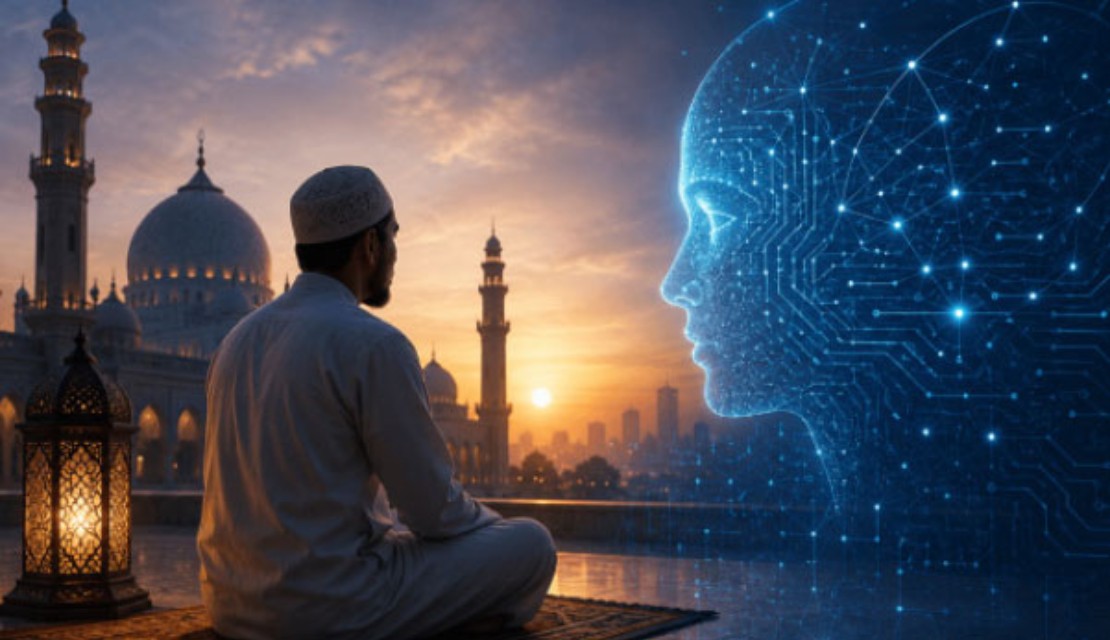
Civilizational survival has rarely been a matter of physical preservation; rather, it is forged in the crucible of intellectual and spiritual sovereignty. In an era where the velocity of technological disruption outpaces the speed of societal adaptation, the Islamic world confronts a tectonic shift that transcends the boundaries of conventional geopolitics. We have arrived at the precipice of a new frontier: the ubiquitous proliferation of Artificial Intelligence (AI). This is not a suite of advanced computational tools designed to optimize economic outputs or streamline logistical supply chains. It is, fundamentally, an ideological architecture, a pervasive force engineered to recalibrate human cognition, dictate decision-making paradigms, and ultimately, manufacture meaning.
The rapid proliferation of generative systems mirrors a contemporary zeitgeist structurally obsessed with velocity, frictionless utility, and inescapable digital tethering. While these profound technological leaps offer unprecedented geopolitical and developmental leverage, they simultaneously smuggle in philosophical presuppositions that violently collide with the traditional Islamic worldview. The central analytical inquiry of our time is not whether to adopt AI, but how to master it ethically. The objective is to navigate this digital labyrinth with profound intentionality, ensuring that the global Ummah retains its moral agency in a global order increasingly outsourced to algorithmic governance.
The Architecture of Islamic Ontology
To comprehend the friction between AI and Islamic civilization, one must first dismantle the illusion that culture is a collection of folkloric nostalgia or inherited habits. The cultural fabric of the Islamic world is a dynamic, continuous articulation of Tawhid, the unyielding principle of divine unity. This ontological framework dictates that every facet of human existence, from the pursuit of statecraft and the structuring of familial bonds to the acquisition of scientific knowledge, is inextricably linked to a higher metaphysical purpose. Unlike the Western post-Enlightenment paradigm, Islam absolutely rejects the bifurcation of the sacred and the secular. Divine ethics are woven into the very DNA of daily life, providing a resilient anchor across turbulent epochs.
Within this civilizational framework, epistemology is inherently consecrated. Knowledge acquisition transcends mere transactional utility; it is a deliberate metaphysical journey designed to cultivate proximity to the Divine. Classical Islamic intellectualism binds empirical discovery to spiritual humility and ethical stewardship. Historically, the scholar ('alim) was never positioned as a sterile dispenser of data. Rather, they served as guardians of societal character, tasked with nurturing a profound moral consciousness grounded in theological revelation and communal trust. Learning, therefore, was relational, transformative, and measured–a stark contrast to the hyper-optimized data consumption championed by modern tech conglomerates.
The Disruption of Communal Transmission
The transmission of this sacred culture is profoundly communal. It thrives within the intricate web of intergenerational relationships, functioning symbiotically through the family unit and the structural hub of the masjid. The family serves as the foundational academy of civic and moral virtue, while the mosque operates far beyond its ritualistic parameters, acting as the epicenter of sociopolitical counsel, communal belonging, and generational continuity. Islamic cultural heritage is not downloaded via isolated nodes; it is breathed into existence through lived example, physical presence, and sustained human interaction.
Tradition, in this context, is not an anchor holding society back, but a highly calibrated compass guiding it forward. Respect for inherited scholarly wisdom does not denote a rigid hostility toward innovation. The rich jurisprudential mechanics developed over centuries demonstrate an extraordinary elasticity, enabling the Islamic world to absorb new socio-economic realities without compromising core ontological truths. Yet, this highly sophisticated ecosystem now faces an existential stress test.
The algorithmic culture that is driven by extreme individualism, secular logic, and the fetishization of speed threatens to short-circuit the historical pathways through which Islamic identity is forged.
Projected Shifts in Epistemic Reliance Among Global Muslim Youth (Ages 16-35)

(Analysis: The data trajectory indicates a severe impending displacement of traditional epistemic authority. As convenience overtakes communal engagement, AI models are rapidly becoming the primary ontological arbitrators for the next generation.)
The Illusion of Technological Neutrality
Consequently, delineating this civilizational friction is not an exercise in apocalyptic alarmism, but a necessary clarion call for strategic vigilance. What renders AI an ideological threat is the pervasive, yet fundamentally flawed, assumption of its neutrality. Code is never entirely objective; algorithms meticulously reflect the biases, geopolitical interests, and philosophical blind spots of their architects. The predominant engineering hubs of the West operate on a strictly materialist baseline, aggressively prioritizing predictive control, data extraction, and user engagement over holistic, spiritual well-being.
For the Muslim world, this structural bias constitutes a critical vulnerability. The cognitive architecture of AI fundamentally ignores foundational Islamic concepts such as taqwa (God-consciousness), the sanctity of human intention, and the reality of the Unseen (al-Ghayb). It systemically flattens the human soul into quantifiable data metrics, replacing the pursuit of deep meaning with the dopamine loop of personalization. We are witnessing a radical redefinition of value itself. When the sacred is outsourced to the algorithmic, we must critically interrogate what type of human subject these systems are quietly engineering.
Implicit Value Embeddings in Dominant Foundational LLMs

(Analysis: The vast majority of underlying training data structurally alienates the communal and spiritual priorities essential to the Islamic worldview, resulting in subtle but pervasive cultural imperialism.)
This phenomenon introduces a phenomenon that geopolitical analysts might term the Islamic Epistemic Threat: the insidious, gradual erosion of indigenous methodologies of knowing, relating, and transmitting virtue. When opaque AI systems assume the role of religious arbiters, curate educational curriculums, and even simulate human emotional companionship, they actively hollow out the institutional pillars of the Islamic world. The danger rarely announces itself with hostility; rather, it seduces through unparalleled convenience. An algorithm prioritizes engagement loops over objective truth, quietly supplanting the rigorous authority of sacred scholarship with the superficial allure of emotionally responsive, yet soulless, machines.
Furthermore, AI architecture inherently champions a radical form of individualism. It traps the user within bespoke digital silos, subtly indoctrinating them with the notion that the self is the absolute center of the universe. This directly contradicts the communal ethos of Islam, wherein spiritual and moral elevation is achieved relationally–through collective worship, societal service, and mutual accountability. The AI-manufactured self is a fragmented, assembled identity; the Islamic self is a meticulously
cultivated soul.
The Ontological Divergence
| Analytical Dimension | The Algorithmic Paradigm (Silicon Valley) | The Islamic Epistemological Framework |
| Primary Objective | Frictionless efficiency and utility maximization. | Moral cultivation and proximity to the Divine. |
| View of the User | An isolated data node driven by consumption. | A Khalifah (steward) bound by communal duty. |
| Nature of Knowledge | Aggregated data; transactional and instantaneous. | Consecrated wisdom; relational and transformative. |
| Ethical Baseline | Secular materialism; subjective moral relativism. | Tawhid; absolute and divinely ordained ethics. |
| Systemic Output | Behavioral prediction and psychological molding. | Spiritual accountability and ethical elevation. |
The Sovereignty of Historical Precedent
Recognizing this hegemonic threat does not require a reactionary rejection of technology. Instead, it demands a profound reclamation of civilizational agency. Long before the term "artificial intelligence" entered the global lexicon, the Islamic tradition established a sophisticated blueprint for ethical innovation. The early Ummah did not merely consume foreign knowledge; they rigorously synthesized and revolutionized it, operating under an intelligence that was deeply ethical, heavily embodied, and spiritually anchored.
The Quranic mandate to intensely observe, reason, and reflect upon the cosmos was never interpreted as a passive suggestion. It catalyzed centuries of unmatched intellectual output, producing polymaths who understood that empirical discovery was the highest form of worship. Whether pioneering advanced surgical techniques, mapping celestial bodies, or codifying algebraic structures, classical Islamic scholars viewed innovation through the lens of human stewardship. Knowledge was a mechanism of gratitude, never a tool for hubristic self-glorification or unchecked exploitation.
AI Integration vs. Communal Epistemic Cohesion (2020-2035)
 (Analysis: Without aggressive institutional intervention, the inverse correlation between unchecked AI adoption and traditional community cohesion will reach critical fragmentation levels by the early 2030s.)
(Analysis: Without aggressive institutional intervention, the inverse correlation between unchecked AI adoption and traditional community cohesion will reach critical fragmentation levels by the early 2030s.)This historical precedent demonstrates that the Islamic world is not inherently allergic to technological disruption. However, the foundational queries were fundamentally different: Advancements were perpetually subjected to rigorous ethical audits. Does this elevate the societal soul? Does it serve the broader Ummah? The equilibrium between aggressive intellectual ambition and absolute spiritual submission remains the crowning geopolitical legacy of Islamic civilization. We are, therefore, not traversing alien terrain. The contemporary imperative is to resurrect this framework, not through nostalgic replication, but by projecting its timeless principles into the digital theater with absolute clarity. Tools must remain subordinate mechanisms of human will; they must never be permitted to morph into algorithmic idols.
Formulating a Strategic Civilizational Response
If the Muslim world is to navigate this digital renaissance with its dignity and sovereignty intact, it must operate with uncompromising intentionality. Muslims cannot afford to remain passive end-users in a game designed by foreign architects. As moral agents, the community is strictly accountable for its digital footprint. The foundational metric of engagement must be niyyah (intention). Are these computational models being deployed

to evade the rigorous discipline of genuine scholarship, or to amplify humanity's capacity for service? Utilizing AI to bypass the necessary friction of spiritual and intellectual maturation guarantees a hollow civilizational collapse.
Furthermore, the mandate of the khalifah does not terminate at the boundaries of the physical biosphere; it extends forcefully into the digital realm. Muslims are ethically obligated to champion data privacy, actively dismantle algorithmic biases, and inject transparency into automated decision-making. Allowing opaque neural networks to dictate justice, morality, or truth is a profound abdication of divine trust. Not every available application warrants adoption. A stringent ethical calculus must be applied: Does a specific software architecture reinforce familial cohesion, or atomize it? Does it amplify the voices of verified scholarly authorities, or artificially replace them with deep-faked simulacra?
To operationalize this resistance, the immediate cultivation of advanced Islamic digital literacy is paramount. The global Muslim populace must critically understand the underlying mechanics, inherent assumptions, and systemic blind spots of these platforms. Without this defensive intellectual armor, the Ummah devolves into a highly manipulated consumer base, passively absorbing alien values through daily screen interaction.
Ultimately, the grand strategy requires the rigorous development of indigenous, Muslim-engineered technological ecosystems. We must transition from mere critics of Western tech to sovereign creators. This involves financing and coding platforms that are not superficially "Islamic" by branding, but structurally aligned with Islamic ethics at the foundational algorithmic level–technologies that prioritize communal wellbeing, protect modesty, and defer to divine sovereignty.
The domestic sphere remains the primary battleground. Families must initiate critical dialogues regarding digital ethics, demonstrating to the youth that the Islamic framework is not terrified of the future, but uniquely equipped to master it. Simultaneously, the masjid must aggressively evolve into a citadel of digital literacy. Religious leadership must be systematically upskilled to address algorithmic realities from the minbar. The vacuum of silence is too dangerous; if authentic leadership retreats from the digital frontier, the algorithmic void will swiftly devour the religious consciousness of the youth.
No individual state or isolated community can unilaterally weather this paradigm shift. It requires a synchronized, transnational effort from the tech incubators in Jakarta to the academic halls of London and the policy centers of Doha. The global Ummah must establish centralized ethical review boards to evaluate AI deployments in public discourse and education. We possess the theological resilience, the historical pedigree, and the intellectual capital to dictate the terms of our technological engagement. AI may rewrite the operating systems of the modern world, but it is the unyielding power of Islamic ethics that will determine the survival and flourishing of the human soul within it.