

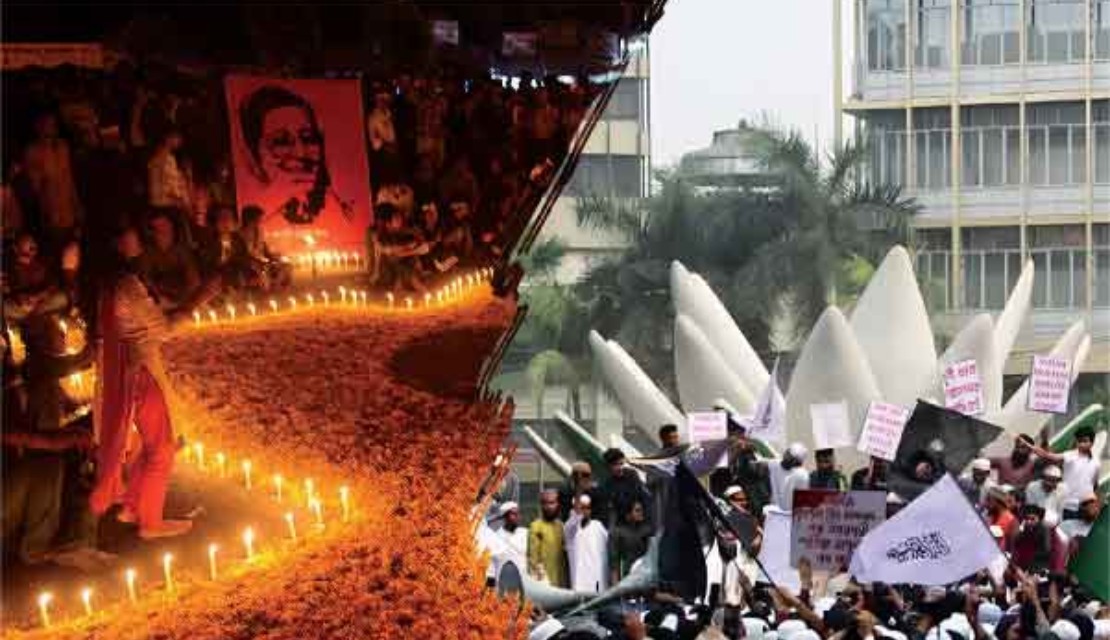
Contemporary politics in Bangladesh has progressed through a complex duality in which state policymaking, cultural orientation, and ideological positions among the public have often stood in sharp conflict with one another. To understand this conflict, the “Shapla–Shahbag” binary serves as an interpretive framework through which competing visions of identity, legitimacy, and power may be examined.
Reducing Shapla and Shahbag to merely two separate events would fail to explain the broader political reality of Bangladesh. Rather, this binary may be understood as representing two symbolic positions. On one side are religious identity, Islamic values, and socially conservative traditions. On the other are secular Bengali nationalism, liberal modernity, and state-backed progressive discourse.
This article explores the binary not simply as an ideological clash, but as part of a broader structural process shaped by global politics, regional influence, domestic power struggles, and cultural hegemony.
Post-9/11 Global Politics and Its Impact on Bangladesh
After the attacks of September 11, 2001, the United States launched the global “War on Terror.” Scholars have argued that the campaign was not only military, but also discursive, reshaping how Islam and Muslim political movements were viewed internationally. Mahmood Mamdani argues that global discourse increasingly categorized cultures rather than only political actors as dangerous (Mamdani, 2004). Edward Said similarly examined how Western media often framed Islam as a monolithic threat (Said, 1997).
Bangladesh was also influenced by this global environment. Security cooperation, counter-extremism programs, and international development agendas increasingly shaped domestic policy discussions (International Crisis Group, 2016). Consequently, religious organizations and Islamist political actors often came under increased scrutiny.
Some analysts argue that after 2008, the Awami League government adopted policies that emphasized secular constitutional principles and intensified regulation of religion-based political forces. Supporters viewed these policies as necessary for democratic secular governance, while critics interpreted them as marginalization of Islamic politics.
Shapla–Shahbag: Symbol and Reality
The Shahbag movement of 2013 emerged around demands for harsher punishment for war crimes committed during the 1971 Liberation War. It attracted significant urban youth participation and was viewed by supporters as a movement for justice and secular nationalism.
In contrast, the Hefazat-e-Islam mobilization culminating at Shapla Chattar in May 2013 represented conservative Islamic activism reacting to issues such as blasphemy, secular politics, and moral
concerns. The subsequent security operation at Shapla remains highly contested. Human rights organizations, journalists, opposition groups, and the government presented sharply different casualty figures and interpretations. International media, including Al Jazeera, reported the event as a violent crackdown on protesters (Al Jazeera, 2013).
Thus, Shahbag and Shapla generated rival narratives about justice, identity, religion, and the future direction of Bangladesh. Michel Foucault’s broader insight that power shapes accepted truth through discourse is relevant in understanding these competing interpretations (Foucault, 1980).
Regulation of Religion-Based Politics
The constitutional history of Bangladesh reflects an ongoing tension between secular nationalism and Islamic identity. The 1972 Constitution emphasized secularism. Later amendments inserted references to Allah and eventually declared Islam the state religion. Subsequent governments retained some Islamic provisions while restoring secularism as a constitutional principle.
Scholars such as Ali Riaz note that Islamist politics in Bangladesh has often been managed through a mixture of participation, regulation, containment, and selective exclusion (Riaz, 2018). This has included party bans, legal restrictions, surveillance, or rhetorical delegitimization at different times under different governments.
Examples often cited in debate include:
1. Constitutional reinterpretation of secularism
2. Regulation of madrasa and religious networks
3. Increased monitoring of Islamist organizations
4. Framing Islamist politics as anti-democratic or extremist
5. Counter-mobilization through media and civil society narratives
Whether these measures protected democracy or unfairly constrained religious political participation remains a subject of intense debate.
Indian Influence and Cultural Hegemony
Antonio Gramsci’s concept of cultural hegemony explains how dominant groups normalize their worldview as common sense (Gramsci, 1971). In Bangladesh, many critics and observers have discussed the strong influence of Indian media, entertainment, and cultural production.
Television serials, films, music, and literary traditions from India have long had influence in Bangladesh. Some celebrate this as natural regional exchange; others argue it can overshadow indigenous and specifically Islamic cultural expressions.
This debate often intersects with identity politics: whether Bangladeshi identity should be defined primarily through Bengali linguistic-national heritage, Islamic civilization, territorial nationalism, or a synthesis of these elements.
Religion, Identity, and Political Conflict
In many Muslim societies, politics is not viewed as separate from moral and religious identity. Therefore, disputes over secularism, nationalism, and state power often become framed in theological or civilizational terms. Thinkers such as Sayyid Qutb interpreted modern secular systems as forms of renewed jahiliyyah (Qutb, 2006).
In Bangladesh, some groups frame conflicts such as Shahbag–Shapla as part of a deeper struggle over values, sovereignty, and moral order. Others reject such binary framings and see the conflict as a contest between democratic pluralism and religious majoritarianism.
This demonstrates that political struggles in Bangladesh are not merely electoral, they are also contests over meaning, memory, and identity.
The “Shapla–Shahbag” binary symbolizes one of the most important ideological tensions in contemporary Bangladesh: religion versus secularism, competing nationalisms, elite versus popular legitimacy, and rival visions of modernity.
It is not merely about two events in 2013, but about unresolved questions in the Bangladeshi state project since independence. Whether Bangladesh can move beyond binary polarization toward an inclusive, democratic, and justice-based political order remains one of the central challenges of its future.