

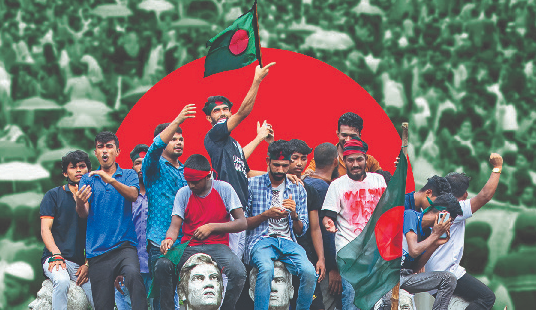
Bangladesh stands at a rare historical inflection point. Nations do not often receive a second chance to renegotiate their political contract with power, nor do societies frequently experience moments when collective disillusionment transforms into organized aspiration. The mass uprising of 2024 was such a moment, not merely an episode of protest, but a structural rupture in the political imagination of the republic. It did not simply challenge a government; it questioned the very architecture of governance that has defined Bangladesh since independence.
For those born in the post-1971 era, the last five decades have unfolded as a cycle of promises deferred, institutions hollowed out, and sovereignty selectively compromised. The uprising of 2024 marked the first time in a generation that despair gave way to clarity. For the first time, a coherent vision emerged, not of who should rule, but of how the state itself must be reconstituted.
We need to rethink of what a functional, sovereign, and self-respecting Bangladesh would require that binds altogether strategically, institutionally, and morally if the country is to escape the historical loop of elite capture and state fragility.
The Exhaustion of the Two-Party Paradigm
Bangladesh’s political crisis is not episodic; it is structural. Over the past 54 years, power has alternated among three dominant political forces, each inheriting the language of liberation while presiding over a steady erosion of institutional trust. None has meaningfully attempted to realize the aspirations of the people; governance has been reduced to survival, patronage, and symbolic nationalism.
The problem, therefore, is not merely leadership failure, it is paradigmatic exhaustion. A political ecosystem built around dynastic legitimacy, personalized authority, and transactional governance cannot deliver a modern state. The uprising of 2024 exposed this exhaustion with unprecedented clarity. What emerged was not simply anti-incumbency sentiment, but a collective demand for a third political force, not defined by lineage or legacy, but by competence, accountability, and strategic clarity. The demand is not ideological radicalism. It is institutional sanity.
Sovereignty as Strategy, Not Slogan
True sovereignty is neither declared nor inherited, it is practiced. For Bangladesh, the restoration of sovereignty must begin with foreign policy, long treated as a balancing act between dependency and silence. A self-respecting state does not outsource its strategic interests, nor does it subordinate national security to diplomatic convenience.
Bangladesh requires a foreign policy anchored in strategic autonomy, not alignment dependency. This does not imply hostility toward neighbors or partners; rather, it demands an unambiguous prioritization of national interest over external pressure. A sovereign foreign policy must be backed by credible deterrence, diplomatic confidence, and strategic foresight. This inevitably leads to defense modernization, not as militarism, but as insurance against coercion.
Rebuilding Deterrence: Air, Land, and Sea
Bangladesh’s security vulnerabilities are geographic, not theoretical. The northern airspace remains exposed; the eastern corridors remain under-defended; the maritime domain remains under-patrolled. These are not abstract risks; they are strategic facts.
The abandonment of Lalmonirhat Airport is emblematic of strategic negligence. Revitalizing it as a full-scale airbase, integrated with a dedicated aerospace university, would not merely modernize the Air Force, it would institutionalize indigenous defense knowledge. A permanent fighter squadron in the north would close a critical gap and reassert control over a historically vulnerable airspace.
Equally alarming is the fragility of Bangladesh’s eastern connectivity. The narrow land corridor linking the Chittagong division and the Bay of Bengal to the mainland represents a strategic choke point. Any disruption would effectively transform Bangladesh into a de facto landlocked state, with catastrophic economic and geopolitical consequences.
The construction of infrastructure without corresponding defense planning, such as unguarded cross-border bridges has compounded this vulnerability. A mechanized infantry division in the eastern frontier, supported by a dedicated airbase in Comilla, is no longer optional; it is a strategic necessity.
At sea, sovereignty extends 200 nautical miles into the Bay of Bengal. Yet surveillance, deterrence, and maritime governance remain underdeveloped. A modern navy with submarines, maritime patrol assets, and real-time surveillance capabilities is essential not only for defense, but for protecting trade routes, fisheries, and energy assets. Without maritime dominance, economic independence remains a myth.
Rule of Law: The Republic’s Missing Spine
No state can claim legitimacy without the rule of law. In Bangladesh, law has been instrumentalized rather than institutionalized. The result is a system where power is insulated, accountability is selective, and justice is performative.
Judicial independence is essential but independence without accountability becomes elitism. In a democratic republic, no institution exists above scrutiny. Judges, like executives and legislators, must be accountable to constitutional standards and ethical oversight. Judicial reform, therefore, must balance autonomy with transparency, speed with fairness, and authority with restraint. Without this balance, the judiciary risks becoming either an extension of power or an untouchable oligarchy. Neither serves democracy.
Legislative Decay and the Crisis of Representation
Parliament, in theory, is the heart of democratic deliberation. In practice, it has become an arena of spectacle, patronage, and legislative trivialization. The absence of minimum educational qualifications for lawmakers has devalued policy debate and degraded institutional seriousness.
Setting a baseline qualification such as a university degree is not elitism; it is professionalization. Lawmaking requires analytical capacity, policy literacy, and constitutional understanding. Public office is not a reward; it is a responsibility.
Equally corrosive is the transformation of MPs into local contractors overseeing roads, distributing relief, and engaging in micro-development. This distorts governance. Legislators must legislate. Executive agencies must execute. Welfare must be institutional, not personalized.
State perks that incentivize rent-seeking, tax-free luxury imports, subsidized real estate must be abolished. Representation should be an act of service, not a gateway to privilege.
Economic Reform Beyond Cosmetic Growth
Bangladesh’s economy has grown, but its institutions have not matured. The banking sector, in particular, has become a reservoir of systemic risk plagued by political interference, loan defaults, and regulatory capture.
Outdated banking laws must be dismantled and replaced with modern regulatory frameworks that insulate financial institutions from political pressure. Bangladesh Bank must operate as a genuinely autonomous central bank, free from executive influence, capable of enforcing discipline and stability.
Price manipulation through syndicates has eroded public trust and distorted markets. Continuous market surveillance, enforced competition laws, and punitive action against cartelization are essential to restore economic fairness.
Employment generation requires more than rhetoric. It demands a business environment that rewards innovation, lowers entry barriers, reduces tax rates while broadening the tax base, and protects investors through predictable regulation. An economy without jobs is an economy without dignity.
Territorial Integrity and Internal Sovereignty
State authority must be indivisible. In regions where parallel power structures exist, whether through insurgency, unregulated NGOs, or administrative withdrawal, the republic weakens itself.
The Chittagong Hill Tracts require renewed state presence, not abandonment. Restoring security installations, regulating external actors, and asserting administrative control are prerequisites for peace, not its enemies.
The Rohingya crisis remains a regional failure of diplomacy. Bangladesh must pursue repatriation through sustained multilateral engagement, strategic alliances, and international legal pressure. Permanent limbo is not a solution; it is a slow destabilization.
Corruption as a National Security Threat
Corruption is not a moral failing alone, it is a strategic vulnerability. It drains resources, undermines institutions, and erodes legitimacy. Anti-corruption efforts must move beyond symbolism.
The Anti-Corruption Commission requires structural independence, prosecutorial authority, and judicial support. Special courts, modeled on fast-track tribunals, should adjudicate corruption cases swiftly. Money laundering must be treated as economic sabotage, with mechanisms to trace, seize, and repatriate stolen assets Impunity must end, not selectively, but systemically.
State Capacity in the Everyday
The quality of a state is often judged not by speeches, but by traffic systems and currency notes. Traffic chaos reflects governance paralysis. Scientific traffic management, law enforcement reform, and infrastructure planning must replace improvisation.
Currency, too, is a symbol of sovereignty. Transitioning to durable polymer notes, designed to reflect cultural heritage without ideological controversy would signal institutional modernization and economic seriousness.
Education as the Republic’s Long Game
No reform will endure without educational transformation. Bangladesh’s fragmented education system has produced fragmented citizens, each taught a different history, identity, and worldview. A unified national curriculum, applied across all educational streams, is essential for social cohesion. This reform must be constitutionalized to prevent politicized revisionism. Education is not a policy choice; it is a civilizational investment. The benefits may take decades, but the cost of inaction is generational division.
Reclaiming What Was Systematically Undermined
Nations collapse not when they lose elections, but when they lose foundations. Military credibility, moral values, educational integrity, and cultural continuity form the pillars of national resilience. In Bangladesh, all four have been systematically weakened. Restoring them is not nostalgic, it is existential.
From Uprising to Republic
Bangladesh does not lack resources, resilience, or resolve. What it has lacked is a state aligned with its people rather than insulated from them. The uprising of 2024 offered more than resistance, it offered a blueprint The demand is clear: a country free from corruption, extortion, extrajudicial killings, and financial plunder; a democracy where all parties practice democratic norms; a republic governed by law, strategy, and accountability.
History has opened a narrow window. Whether Bangladesh steps through it will determine not only its political future, but its survival as a sovereign, self-respecting nation. The moment demands more than change. It demands reconstruction.