

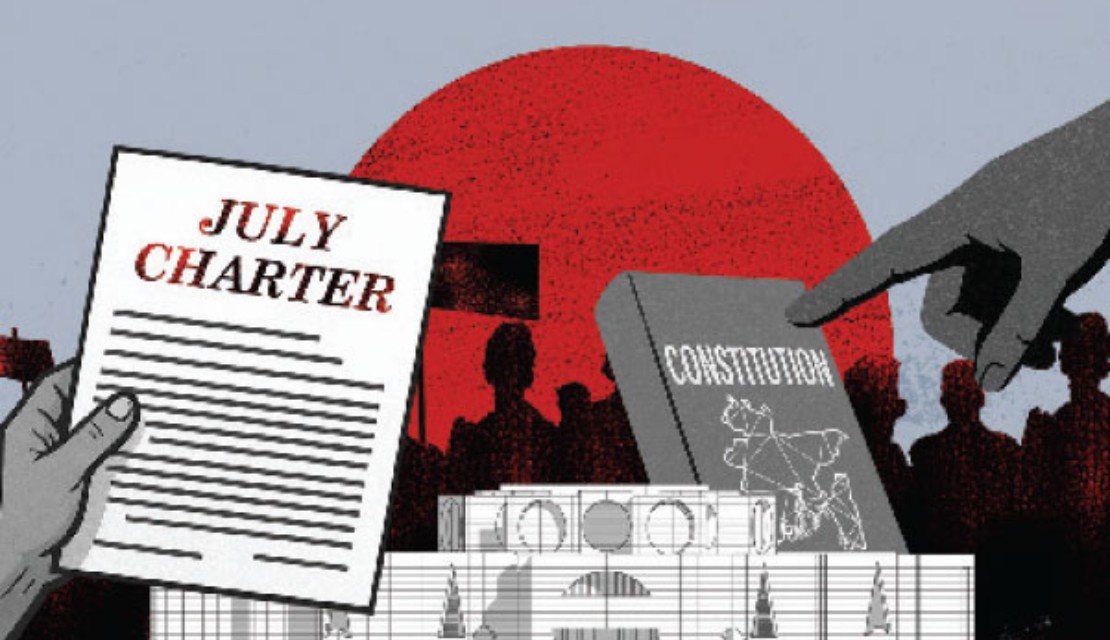
Revolutions are rarely measured by the sheer volume of their casualties or the immediate toppling of authoritarian regimes; rather, they are historically quantified by the magnitude of the collective hope they manage to generate within a fractured society. When the dust finally settles and the street barricades are slowly dismantled, a newly formed transitional administration inevitably inherits a highly fragile political ecosystem built entirely upon the ultimate sacrifices of the ordinary populace. The spectacular summer insurrection, an event now permanently immortalized within the national consciousness as the July Uprising was precisely such a transformative geopolitical earthquake. It was never intended to be a mechanical changing of the political guard or a simple constitutional transfer of administrative authority from one elite faction to another. Instead, it was universally understood as a profound, blood-soaked pledge to fundamentally reconstruct the entire decaying state apparatus from the ground up.
Citizens willingly bled on the unforgiving asphalt for a radically new political paradigm where the strict rule of law would become an undeniable, lived reality, not just a theoretical luxury debated by academics. The core public expectation was explicitly clear: the immediate creation of a fiercely sovereign judiciary, the implementation of a flawless electoral mechanism completely immune to executive manipulation, and the fostering of a modern culture of rigorous accountability across every single bureaucratic institution. Above all, the traumatized people demanded an absolute, permanent end to the notoriously dark era of enforced state disappearances, extrajudicial torment, and systematic political vendettas.
Yet, as the calendar advances, an incredibly unsettling bureaucratic paralysis seems to have deeply infected the inner sanctums and fortified corridors of the new political power center. The single most critical question currently echoing through the intellectual salons, university campuses, and civic spheres today is both urgent and profound: to what precise extent has this sacred, blood-written pledge actually been honored by the victors? A pervasive, almost palpable sense of political disillusionment is rapidly metastasizing across various critical sectors of the national society. The current administration’s glaring lack of tangible, measurable progress in operationalizing the much-anticipated provisions of the historic July Charter has sparked profound public anxiety. Official government narratives continuously insist that comprehensive state reforms are quietly incubating behind heavily guarded closed doors, but the open public square remains conspicuously devoid of any visible, structural milestones. This widening, dangerous gap between soaring revolutionary rhetoric and grinding bureaucratic reality was starkly illuminated by recent legislative controversies surrounding the deeply debated proposed national referendum. When a highly visible, senior cabinet official casually suggested on the floor of the national parliament that the government primarily supported the referendum as a clever tactical maneuver to avoid delaying upcoming parliamentary elections, it fundamentally shifted the parameters of the national political discourse.
The Anatomy of a Stalled Institutional Transition
● Primary Societal Catalyst: Unprecedented youth-led civic mobilization and widespread urban popular uprising.
● Core Public Demand: Comprehensive constitutional and state reform prioritized over mere cyclical electoral rotation.
● Current Institutional Status: Highly stagnant (Independent Judiciary Secretariat and Constitutional Reform Council remain pending).
● Rhetorical Shift Metric: A deeply alarming surge in hyper-partisan political vitriol completely overshadowing substantive policy debate.

This specific articulation implies a deeply transactional and cynical view of modern democratic mechanics. If a national referendum arguably the most direct, sacred, and powerful tool of unmediated public consensus is suddenly relegated to being a mere logistical stepping stone utilized exclusively for partisan electoral expediency, the profound moral weight of the people's hard-won democratic verdict is dangerously and irreparably marginalized. True, functioning democratic governance inherently understands that a national referendum is never a bureaucratic hurdle to be cleared by savvy politicians; rather, it is the ultimate, undeniable manifestation of sovereign public will. By actively reducing this monumental democratic exercise to a simplistic timeline management strategy, the current administration risks heavily insulting the very same politically awakened electorate that recently granted it international legitimacy. To accurately comprehend the severe, long-term implications of this administrative misstep, one must carefully revisit the underlying philosophical bedrock of modern democratic statehood. In any successfully functioning democratic framework, the general populace remains the ultimate, untouchable sovereign entity. As the legendary Enlightenment political thinker Jean-Jacques Rousseau so astutely articulated centuries ago, true sovereign power resides exclusively and permanently within the collective will of the ordinary people. This core foundational axiom is the absolute lifeblood of modern political legitimacy and institutional authority.
Consequently, when a ruling government’s overarching policy trajectory fundamentally fails to mirror the deep existential expectations of its heavily taxed citizens, deep-seated societal frustration is not merely a possibility; it is a highly predictable, entirely rational, and mathematically inevitable civic response.
The prominent twentieth-century philosopher Hannah Arendt further warned political leaders that the greatest and most resilient strength of any structural political power relies entirely upon the continuous, active collective consent of the governed populace. That vital societal consent rapidly and dangerously evaporates the moment a gaping, unbridgeable chasm emerges between the lofty, idealistic objectives loudly declared during times of violent public struggle and the highly pragmatic, often cynical actions executed once absolute state power is finally secured.
The Glaring Disconnect Between Electoral Mandate and Executive Execution
● The Core Expectation: An immediate, decisive legislative mandate to aggressively establish a Constitutional Reform Council tasked with overhauling severely compromised state machinery.
● The Harsh Reality: Indefinite, unexplained bureaucratic delays, intentionally coupled with a baffling, regressive restoration of legacy judicial frameworks instead of pioneering structural innovation.
● The Societal Consequence: A rapid, terrifying erosion of fundamental public trust, triggering the gradual, silent, and insidious rehabilitation of autocratic-era political enablers.
While ruling authorities routinely cite the absolute necessity of extended timeframes for implementing complex, systemic institutional overhauls, the unforgiving theater of modern politics strictly demands both highly logical public explanations and visible, decisive forward momentum. Unfortunately, the current political momentum seems aggressively directed toward an entirely different, highly partisan objective. A detailed, cursory observation of contemporary legislative debates, prime-time television broadcasts, and high-profile public demonstrations reveals a deeply troubling tactical political pivot. The unifying rhetoric of national reconciliation and structural reform has been aggressively and intentionally eclipsed by a hyper-partisan psychological compulsion to completely neutralize historical ideological rivals. Prominent politicians are currently expending massive, unprecedented amounts of organizational energy delivering highly vitriolic, deeply polarizing speeches aimed squarely at their traditional political adversaries, particularly focusing their highly coordinated rhetorical ire on specific minority political entities. While engaging in spirited, competitive debate is undoubtedly a core hallmark of a healthy free society, the existential danger quickly arises when this relentless adversarial posturing completely and utterly consumes all available political oxygen. When the urgent, universally recognized necessity of systemic structural reform is deliberately pushed to the forgotten margins of governance, public patience shatters.

The Alarming Fragmentation of Current Governing Discourse
(Based on extensive qualitative evaluations of recent mainstream national political rhetoric)
70% : Direct, highly aggressive rhetorical attacks on traditional political rivals and ideological adversaries.
20% : Strategic, behind-the-scenes consolidation of executive power and aggressive early election preparation.
10% : Substantive, actionable, and transparent public discussion regarding critical state reforms and the July Charter.
This deliberately engineered rhetorical imbalance is highly alarming to international observers. Renowned political scientists Steven Levitsky and Daniel Ziblatt have comprehensively and meticulously documented how once-stable democratic institutions inevitably begin to rot from the inside out when domestic political rivals are relentlessly framed as dangerous existential enemies rather than entirely legitimate, albeit differing, democratic competitors. By consistently treating traditional adversaries as literal threats to be forcefully eradicated rather than intellectual opponents to be respectfully debated, the ruling government actively and knowingly contributes to the fatal erosion of institutional trust.
In the highly volatile, heavily polarized political reality of today's transitional society, willfully ignoring this established scholarly warning is a guaranteed recipe for unmitigated democratic disaster. The transitional administration is foolishly prioritizing the immediate, short-term management of executive authority entirely over the incredibly difficult, highly unglamorous, and desperately needed long-term work of comprehensive institutional rehabilitation.
Compounding this severe institutional neglect is an active, deeply problematic legislative effort to continuously sanitize and aggressively manipulate the sacred historical narrative of the recent mass mobilization. This rewriting of history intentionally divides the nation.
The Documented Architecture of Imminent Democratic Regression
● Apex: Completely abandoning the core Constitutional Reform mandate.
● Level 2: Weaponizing legislative rhetoric to criminalize legitimate rivals.

● Level 3: Alienating reformist youth and fracturing national consensus.
● Base: Systemic institutional decay enabling an autocratic resurgence.
The traumatized people believed their suffering would translate into political wisdom. The critical questions resonating across the recovering nation today are absolutely not merely the petty partisan grievances of an opposition faction; they are the urgent demands of a truly sovereign people. The citizens desperately envision an impenetrable environment where the overarching administration operates with entirely blind impartiality, and where the haunting nightmare of politically motivated harassment is permanently eradicated. Securing the architectural integrity of the reformed state is vastly more critical than publicly humiliating a historical political rival. Ultimately, true victory belongs only to a depoliticized state.