

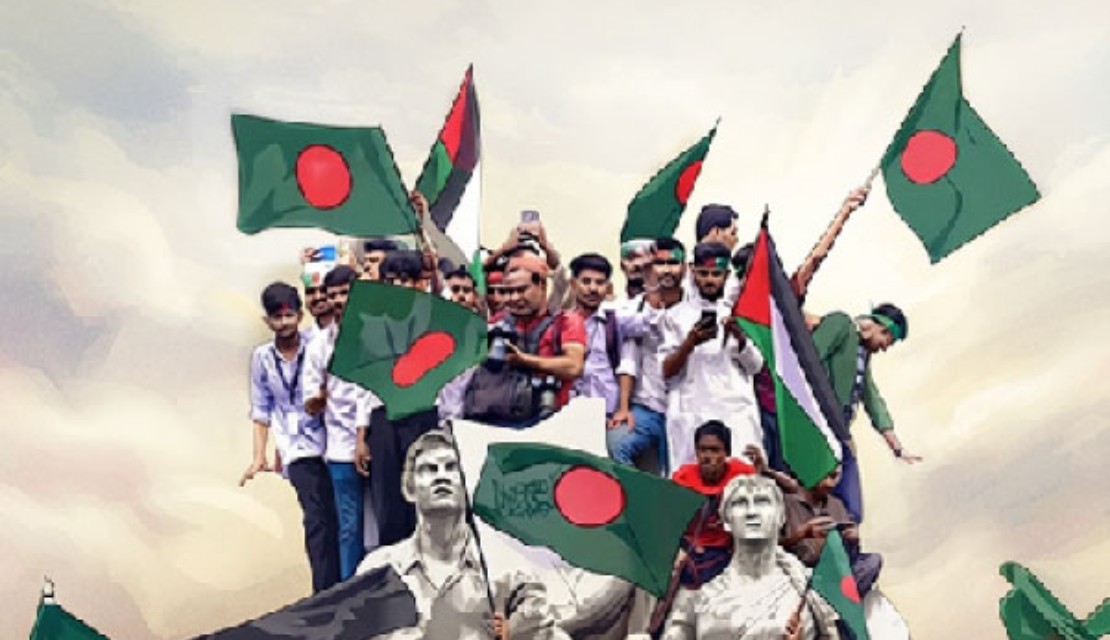
Rebuilding an entire state order from the calcified ruins of a fifteen-year authoritarian regime demands strategic recalibration, patience, and intense institutional overhaul. Yet, a severe analytical fallacy has increasingly begun to dominate intellectual discussions regarding contemporary Bangladesh: the bad-faith conflation of post-revolutionary reconstruction friction with the fundamental failure of the revolution itself. To judge the success of a revolutionary breakthrough by the immediate perfection of its post-revolutionary governance is to fundamentally miscomprehend the basic mechanics of political transformation.
The July Uprising, which culminated in the sudden collapse of Sheikh Hasina’s autocratic apparatus and her dramatic exile, was an unequivocal, historic triumph. Its success indelibly stamps its mark upon history through the complete dismantling of a police state that many believed was permanent. The phase Bangladesh finds itself in today is the post-revolutionary chapter, a complex interregnum where success or failure will be determined by collective civic effort over time. However, the uprising itself stands as an absolute victory. Why, then, has a persistent, highly orchestrated narrative emerged attempting to present the July Uprising as an abject failure? To comprehend this phenomenon, one must analyze the specific political identity of those driving this narrative and expose the underlying ideological project behind their rhetoric. Opinion is never neutral; it is an instrument of power.
The Irrefutable Mechanics of Overthrow
To evaluate the July Revolution objectively, one must decouple the heroic act of liberation from the messy realities of statecraft that follow. The central question must be asked: Was the revolution successful? From a structural standpoint, the answer is indisputably positive. The explicit, overarching goal of any mass rebellion against an entrenched dictatorship is the total destruction of that regime’s monopoly on power. For a decade and a half, Sheikh Hasina presided over a draconian apparatus that systematically subverted the judiciary, paralyzed democratic institutions, and turned state security forces into private enforcers. It was a regime widely considered unshakeable by conventional political metrics.
Yet, within an astonishing span of just twenty-one days, an organic popular explosion completely obliterated this authoritarian architecture. The catalyst for this sudden collapse was not abstract political ideology but a profound, collective moral outrage. This visceral shift was captured powerfully when, apart from the revolution vanguard like the students and mass people, there were public cultural icons who took to the streets, articulating the raw horror gripping the nation: "They are killing small children; we cannot sleep at night." This authentic grief resonated across every socio-economic class, compelling hundreds of thousands of parents to march alongside the youth. The public reached a decisive consensus: a government that murders its own children has forfeited its right to exist. The revolution did not extract concessions; it achieved the total overthrow and flight of a tyrant. To question the success of the July revolution is to deny the concrete reality of Hasina’s exit and the emancipation of Bangladesh from Awami League dominance.
Civil Liberties and the Restoration of Civic Life
Furthermore, those who dismiss the post-July era as a failure deliberately obscure the radical restoration of basic human rights achieved over the past five months under the interim administration. Under Hasina’s rule, state terror was a daily reality, enforced through systematic disappearances, extrajudicial executions, and pervasive digital repression. Between 2013 and 2018 alone, over 1,300 cases were prosecuted under draconian information technology laws, weaponized to incarcerate citizens for harmless social media posts criticizing Hasina or her family, including the notorious case of a 23-year-old youth sentenced to seven years in prison. Today, we have lifted that shadow of fear. lifted. Enforced disappearances have ceased, state-sanctioned extrajudicial killings have ended, and public discourse has experienced an unprecedented liberation. Ministers, members of parliament, and state administrators Public forums openly scrutinize, lampoon, and hold ministers, members of parliament, and state administrators accountable without subjecting them to midnight abductions or arbitrary imprisonment. They are held accountable across public forums without facing midnight abductions or arbitrary imprisonment.
Simultaneously, the mechanics of representative democracy have begun to re-emerge from the ashes. Through the restoration of the right to vote, a new parliament has taken shape. While both the ruling coalition and opposition factions exhibit operational growing pains, legislative business is once again conducted through genuine parliamentary debate, critical review, and public policy scrutiny. For the first time in modern Bangladeshi history, the relationship between the ruling bench and the opposition in parliament is characterized by institutional decorum rather than existential hostility. Crucially, over these five months, the parliamentary opposition has eschewed destructive street violence, general strikes, blockades, and arson, opting instead to press its demands through legitimate assemblies, public rallies, and robust debate. This shift marks a profound maturation of the country's political culture.
The Leftist Cultural Front and the Architecture of Complicity
If the metrics of liberation, civil liberty, and institutional normalization are so evident, who benefits from branding this post-revolutionary chapter a failure? The answer lies within Bangladesh’s legacy left-progressive intelligentsia, a faction that functioned for fifteen years as the intellectual front and cultural enabler of Hasina’s autocracy. To understand their current hostility toward the July Uprising, one must trace their political genealogy. Following the fall of Sheikh Mujibur Rahman’s one-party BAKSAL regime in 1975 and the subsequent revival of multi-party democracy under Ziaur Rahman following November 7, the pro-Moscow leftist ecosystem faced political extinction. To survive, these leftist elements systematically converted themselves into the cultural militia of the Awami League.
Anchored in an acute Islamophobia, this left-progressive bloc spent decades crafting a deceitful narrative designed to sell the Awami League to the urban middle class as a "center-left, liberal democratic" bulwark against religious extremism. In doing so, they deliberately painted mainstream democratic opposition forces, particularly the Bangladesh Nationalist Party (BNP) and Bangladesh Jamaat-e Islami (BJI), as dangerous fascist proxies. Throughout Hasina’s brutal reign, while genuine opposition leaders from the BNP and Jamaat-e-Islami were being executed, forcibly disappeared, or driven into hiding, these leftists were granted a state-sanctioned pleasure arena. There, they delivered fiery, performative speeches into state-sanctioned microphones. This orchestrated "opposition" provided Hasina’s police state with a democratic facade, working in tandem with domestic political constructs like the puppet Jatiya Party. In exchange for this controlled relevance, the Left legitimized the regime's authoritarianism under the guise of secular progressivism. The arrangement is completely pre-planned. They are orchestrating a larger scheme using the binary distinction between "senior journalist" and "analyst."
Electoral Bankruptcy and Narrative Sabotage
The July Revolution did not just overthrow a tyrant; it destroyed the entire ideological superstructure that sustained her regime. In the subsequent democratic space, the electorate rendered a devastating verdict against these legacy leftists. During the recent electoral process, left-progressive candidates suffered a catastrophic defeat, forfeiting their financial deposits across virtually every contested seat. Conversely, new political formations emerging directly from the mass uprising, such as the National Citizen Party (NCP), alongside small Islamist parties like Khilafat Majlis, secured parliamentary representation. The Bangladeshi public clearly recognized that the traditional left was never an independent political force but rather a subsidiary of the Awami League machine.
Rejected by the voters and stripped of their autocratic patron, these self-styled progressives have now pivoted to narrative sabotage. By incessantly asking, "What did we actually achieve from the uprising?" they seek to undermine the moral legitimacy of the revolution and defame the sacrifices of those who bled for freedom. They weaponize the natural administrative frictions of the post-revolutionary transition to argue that life under the autocracy was preferable, attempting to pave the path for the rehabilitation of Awami rule. They brazenly attempt to equate the newly formed, democratically engaged parliament with the fraudulent, subservient institutions of the Hasina era, desperately trying to re-impose a discarded hegemony of Hindutva-aligned cultural aggression disguised as secular progressivism.
The Impossibility of Authoritarian Restoration
Ultimately, this campaign to tarnish the July Uprising is the final desperate stand of a bankrupt political elite. The legacy leftists are attempting to put on the worn-out shoes of the fallen regime, forgetting that the revolution destroyed not only the tyrant but also the intellectual illusions that kept her in power. The Bangladeshi people have permanently rejected the toxic trade-off between democratic freedom and pseudo-secular authoritarianism. While the road to rebuilding the nation remains long and filled with structural hurdles, the July revolution remains an unassailable victory. Those attempting to brand it a failure are not neutral analysts; they are the grieving enablers of a dead autocracy.