

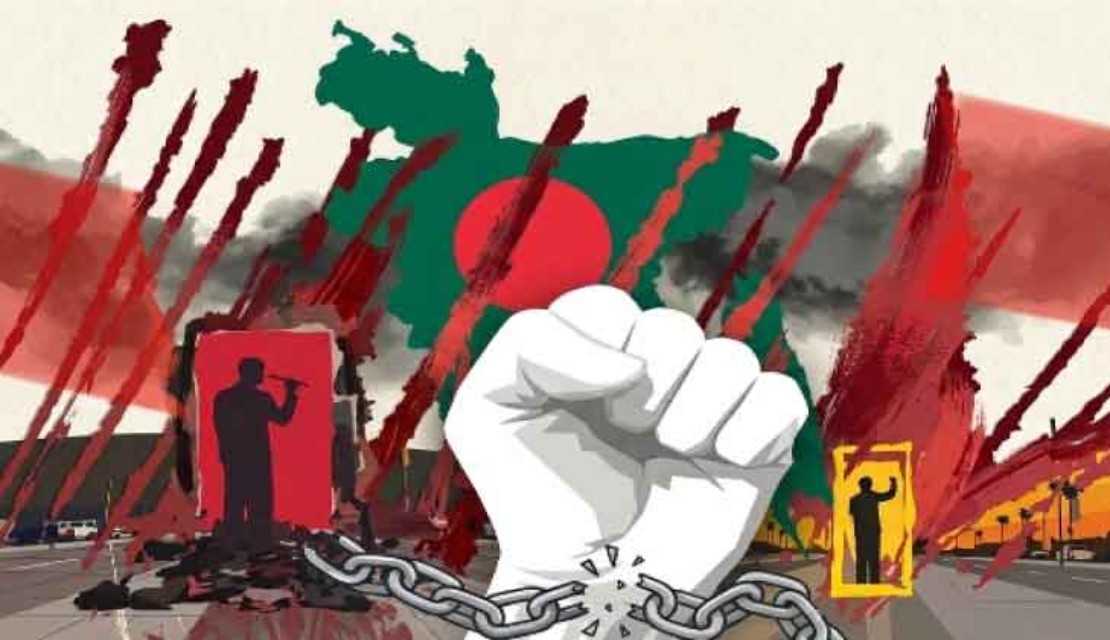
Bangladesh stands at one of the most consequential moments in its political history since independence. The popular uprising of 2024 and the general election of 2026 have together created what constitutional scholars would describe as a "constitutional moment", a rare period in which a nation possesses both the political legitimacy and public mandate to fundamentally reshape its governing institutions.
The question confronting Bangladesh today is therefore larger than the outcome of an election. It is not simply about who governs. It is about how power will be exercised, how institutions will be designed, and whether the country can finally break free from a political cycle that has repeatedly undermined democratic development since independence. The answer will determine whether Bangladesh experiences a genuine democratic renaissance or merely another iteration of political dominance under different leadership.
The Long History of Interrupted Democracy
Since its birth in 1971, Bangladesh has struggled to establish a stable equilibrium between democratic aspirations and political realities. The country emerged from the Liberation War with promises of democracy, justice, constitutionalism, and popular sovereignty. Yet those aspirations quickly encountered profound challenges.
The assassination of Sheikh Mujibur Rahman in August 1975 represented more than the death of the country's founding leader. It marked the collapse of the first constitutional order of independent Bangladesh and ushered in a prolonged period of political instability. Military interventions, coups, counter-coups, and constitutional experimentation became recurring features of the political landscape.
The assassination of President Ziaur Rahman in 1981 further demonstrated the fragility of political institutions. Leadership changed, governments changed, and constitutions were amended, but the fundamental problem remained the same: political authority continued to revolve around individuals rather than institutions. This distinction is crucial. Democratic procedures may exist without democratic culture. Elections may occur without constitutional restraint. Institutions may formally exist while lacking genuine independence. Throughout much of Bangladesh's post-independence history, constitutional structures often struggled against the realities of personalized political power.
The Promise and Failure of Democratic Restoration
The restoration of parliamentary democracy in 1991 was celebrated both domestically and internationally as a historic achievement. Following years of military and quasi-military rule, Bangladesh appeared poised to embark on a path of democratic consolidation. Yet the promise of 1991 gradually became trapped in an endless cycle of political confrontation. The country's two dominant political forces transformed politics into a winner-takes-all contest. Parliamentary boycotts became routine. Elections were frequently disputed. Political opponents were often treated not as legitimate competitors but as existential threats.
As a result, democracy survived but failed to mature. Governments changed through elections, but political culture remained largely unchanged. Constitutional institutions became increasingly vulnerable to partisan influence. The state itself often became an arena for political contestation rather than a neutral framework within which competition could occur. The fundamental problem was not the absence of elections. It was the absence of institutional trust.
The Awami League Era: Development and Democratic Erosion
The period following 2008 constituted another major turning point in Bangladesh's political evolution. Few observers would deny that Bangladesh achieved significant economic progress during this period. Economic growth accelerated, infrastructure expanded, poverty rates declined, and Bangladesh increasingly emerged as a development success story within South Asia. However, these achievements were accompanied by persistent allegations of corruption surrounding major infrastructure projects, significant cost overruns, and rising public debt. Critics argued that the government's ambitious mega-project agenda exceeded the country's economic capacity, leaving a substantial debt burden on future generations. While headline economic indicators remained strong, many ordinary citizens struggled with inflation and rising living costs, leading some analysts to describe the economy as increasingly fragile and overly dependent on debt-fuelled growth. Yet economic success alone could not resolve deeper political concerns.
Over time, questions emerged regarding shrinking political space, restrictions on dissent, allegations of enforced disappearances, constraints on media freedom, and declining confidence in electoral competition. Formal democratic institutions remained intact, but many observers increasingly questioned whether their substantive independence had been compromised. This distinction between formal democracy and substantive democracy lies at the heart of modern constitutional debates. A country may possess elections, courts, and legislatures on paper. Yet if those institutions cannot operate independently, democratic legitimacy gradually weakens. By the early 2020s, growing sections of Bangladeshi society had come to believe that political competition was no longer taking place on equal terms.
The Uprising of 2024: A Rejection of a Political System
Against this backdrop, the popular uprising of 2024 emerged as a watershed event. Its significance extends beyond the fall of a government. The uprising represented a broader rejection of a political order that many citizens viewed as increasingly centralized, exclusionary, and unresponsive. It reflected frustration not only with particular leaders but also with the institutional arrangements that had enabled the concentration of power.
Public demands increasingly focused on accountability, transparency, electoral integrity, and constitutional reform. The subsequent transition under the interim administration led by Muhammad Yunus created a rare opportunity for national renewal. Expectations were extraordinarily high. Citizens sought not merely a change in leadership but a transformation in the character of governance itself.
In many respects, Bangladesh entered a period comparable to transitional moments experienced by countries emerging from authoritarian or semi-authoritarian rule. The challenge was no longer simply changing governments. The challenge was redesigning the rules of the game.
Why the 2026 Election Was a Constitutional Moment
The general election of 2026 was far more than a routine electoral contest. Ordinary elections answer a simple question: who governs? The 2026 election answered a far more profound one: what kind of state does Bangladesh wish to become? Combined with public endorsement of institutional reforms through the July Charter process and referendum, the election created an unprecedented opportunity to reshape the country's constitutional architecture. Such moments are rare in the history of nations. They appear perhaps once in a generation, offering political leaders and citizens alike an opportunity to redefine the rules of governance and rebuild public institutions.
The election produced a new political landscape. The BNP-led alliance secured a strong parliamentary mandate, while Jamaat-e-Islami emerged as the principal opposition force. As a result, the long-standing political binary that had dominated Bangladesh for decades was fundamentally disrupted. For the first time in a generation, debates about constitutional design, judicial independence, electoral integrity, decentralisation, accountability, and institutional reform moved to the centre of national politics. The focus shifted from personalities and partisan rivalries towards questions about how the state itself should function.
Yet history suggests that transitions often fail precisely at this stage. Political movements that successfully remove an unpopular government frequently discover that winning power and governing democratically are not the same thing. Many governments mistake electoral victory for democratic consolidation, assuming that a strong mandate entitles them to exercise power with minimal restraint. In reality, democratic consolidation requires something far more demanding than electoral success.
Winning power is relatively easy; building institutions capable of constraining power is considerably more difficult. The true test of democratic commitment is not how a government exercises authority when it possesses overwhelming public support, but whether it is willing to establish safeguards that may one day limit its own power. Bangladesh's future will therefore depend not on the outcome of a single election, but on whether its political leaders can transform a moment of popular triumph into a durable framework of constitutional governance.
The Government's Historic Responsibility
The new government must therefore recognize that its mandate is constitutional rather than merely political. Voters did not simply choose a new governing coalition; they rejected an entire political era. The electorate entrusted power to new leaders with the expectation that the abuses, excesses, and institutional distortions of the past would not be repeated. The message from the ballot box was clear: political change must be accompanied by structural change. Citizens did not vote merely for a transfer of power; they voted for a transformation in how power is exercised.
Achieving that transformation requires meaningful institutional reform. Citizens expect an independent judiciary capable of commanding public confidence, an electoral commission that enjoys credibility across political divides, a professional civil service insulated from partisan pressure, and law enforcement agencies that serve the republic rather than any ruling party. Above all, they expect institutions strong enough to restrain future governments regardless of ideology or political affiliation. The true test of democratic commitment is not how governments exercise power when they possess it, but how willing they are to limit their own power while they possess it. Democracies become durable not when leaders accumulate authority, but when they build institutions capable of holding every future government accountable.
The Role of Parliament as a Reforming Assembly
The significance of the new parliament extends far beyond ordinary legislation. In many respects, the current parliament functions as a reforming assembly entrusted with the historic task of reshaping Bangladesh's democratic institutions. Its responsibility is not simply to determine who governs today, but to establish the constitutional and institutional safeguards that will constrain power tomorrow. The decisions taken during this parliamentary term may shape the trajectory of Bangladeshi democracy for decades to come.
Constitutional history consistently demonstrates that durable democracies emerge when governing parties voluntarily accept limits on their own authority. The most successful democratic systems are built upon a simple but profound recognition: today's opposition may become tomorrow's government, just as today's government may one day find itself in opposition. For that reason, democratic rules must be designed not for immediate partisan advantage but for long-term political stability and institutional integrity. Bangladesh now faces precisely this challenge. The true legacy of the present parliament will not be measured by the laws it passes or the political victories it secures, but by whether it can build institutions strong enough to protect democracy regardless of who holds power in the future.
Reform Versus Resistance
Early signs suggest that tensions are already emerging around the implementation of reform. Public support for structural changes was clearly demonstrated during the referendum process associated with the July Charter, reflecting a widespread desire to strengthen democratic institutions and prevent a return to authoritarian practices. However, disagreements have begun to surface regarding the pace, scope, and sequencing of these reforms. While some political actors advocate rapid and comprehensive change, others favour a more gradual approach, citing concerns about political stability and administrative capacity.
Such disagreements are neither surprising nor necessarily unhealthy. In fact, democratic systems thrive on debate, negotiation, and competing visions of reform. Nevertheless, prolonged delays, half-hearted implementation, or selective adoption of reform measures risk undermining public confidence in the transition process. If citizens begin to perceive that reform promises are being diluted or postponed indefinitely, tensions between the government, opposition parties, and civil society organisations are likely to intensify. Consequently, the struggle over reform implementation may become the defining political contest of the coming decade, shaping not only the success of the current government but also the future direction of Bangladesh's democratic development.
Economic Governance: The Decisive Test
Constitutional reform alone cannot guarantee democratic success. Economic performance will prove equally decisive in determining whether the post-2026 political transition is ultimately viewed as a success or a failure. Political legitimacy may be won through elections, but economic legitimacy must be earned through results. Citizens who demanded political change will eventually judge the government not only by its commitment to constitutional reform but also by its ability to improve everyday life.
The challenges are considerable. Bangladesh continues to face inflationary pressures, slower economic growth, energy insecurity, concerns over foreign exchange reserves, and an increasingly uncertain global economic environment. In addition, the new government has inherited the burden of substantial public debt and the long-term financial obligations associated with major infrastructure projects undertaken during the previous administration. Addressing these structural weaknesses while maintaining economic stability will require difficult policy choices and effective governance.
Ultimately, voters will ask practical rather than theoretical questions. Can the government create jobs for a growing workforce? Can it stabilise prices and ease the burden of inflation on ordinary families? Can it attract domestic and foreign investment while restoring confidence in the economy? Can it improve living standards and ensure that economic growth benefits society as a whole rather than a privileged few? Without meaningful economic improvement, even the most ambitious programme of democratic and constitutional reform risks losing public support. Democratic transitions are sustained not only by political freedoms and institutional safeguards, but also by a government's ability to deliver tangible improvements in the lives of its citizens.
The Awami League Question
Perhaps the most sensitive issue concerns the future of the Awami League. History suggests that major political forces rarely disappear permanently. Experiences from countries such as Indonesia, South Korea, and Spain demonstrate that democratic stability ultimately requires a combination of accountability and political inclusion. This does not imply immunity from legal responsibility. Individuals must be held accountable where evidence supports allegations of wrongdoing.
Yet democratic legitimacy depends upon transparent, credible, and impartial legal processes. Justice and revenge are not synonymous. If accountability is perceived as politically motivated, democratic renewal could lose credibility. If accountability is administered fairly and consistently, confidence in the rule of law may be strengthened. The broader principle remains clear. Democracy depends upon regulated competition among political forces rather than their permanent exclusion.
Any future reintegration of the Awami League into competitive politics would necessarily require organizational reform, leadership renewal, and engagement with the legacy of the past. Yet mature democracies permit parties to lose, reform, and compete again. They do not seek permanent victories over political opponents.
The Central Question
Ultimately, Bangladesh's challenge is not primarily electoral; it is cultural and constitutional. For decades, the country has struggled with the same underlying pattern: personalistic politics, winner-takes-all governance, the politicisation of state institutions, and an excessive concentration of power in the hands of those who govern. The names of political actors have changed, governments have risen and fallen, and political alliances have shifted, yet the underlying pattern has remained remarkably consistent. Too often, political competition has been viewed as a battle for total control rather than a contest within a framework of shared democratic rules.
The fundamental question confronting Bangladesh today is therefore not who governs, but how power will be exercised. Will the new political order reproduce the habits of centralisation, exclusion, and political dominance that characterised previous eras, or will it establish a more accountable, pluralistic, and institution-based democratic system? Will today's governing majority strengthen institutions that may one day constrain its own authority? Will the opposition embrace its constitutional role as a responsible alternative government rather than a force of perpetual confrontation? Most importantly, will political leaders across the spectrum learn from the failures of the past and recognise that democracy is sustained not by the goodwill of individuals but by the strength of institutions?
The answers to these questions will determine whether the events of 2024 and 2026 represent a genuine democratic turning point or simply another chapter in Bangladesh's long cycle of political repetition. The country's future depends not merely on changing governments, but on changing the political culture that has repeatedly undermined democratic consolidation since independence.
A Rare Opportunity
The uprising of 2024 opened a door, and the election of 2026 created an opportunity to walk through it. Together, they offered Bangladesh a rare chance to transform a moment of crisis into a foundation for democratic renewal. Yet history shows that such opportunities are not guaranteed to succeed.
The voters have already done their part. Through both protest and the ballot box, they demanded accountability, reform, and a more democratic political order. The responsibility now lies with political leaders, opposition parties, civil society, and state institutions. History has given Bangladesh another chance. The challenge is to ensure that this moment becomes the foundation of democratic consolidation rather than another chapter in the country's long cycle of political disappointment. The ballot box has spoken; now history waits to see whether Bangladesh's leaders are prepared to listen.