

Rivers rarely remain mere rivers in South Asia. They become borders, instruments of survival, and, at times, quiet weapons of statecraft. Nowhere is this transformation clearer than in the approaching expiration of the 1996 Ganges Water Sharing Treaty between India and Bangladesh. What once appeared to be a landmark of bilateral cooperation is now emerging as a potential arena of strategic confrontation.
As December 2026 approaches, the treaty’s expiration is no longer a routine diplomatic milestone. It has become entangled in a far broader transformation. The Ganges question, therefore, is not simply about hydrology. It is about sovereignty, influence, and the subtle architecture of regional power.
The Architecture of a Historic Deal
The Architecture of a Historic Deal
When the Ganges Water Sharing Treaty was signed in New Delhi on December 12, 1996, it was hailed as a diplomatic breakthrough. Indian Prime Minister H. D. Deve Gowda and Bangladeshi Prime Minister Sheikh Hasina framed the agreement as the long-awaited resolution to decades of disputes over the Farakka Barrage and the distribution of dry-season flows.
The structure of the treaty was technically precise but politically ambitious. Each year between January 1 and May 31, the dry season when water scarcity is most acute, the two countries would share flows measured at the Farakka point under a tiered formula. If the water flow dropped below 70,000 cusecs, both sides would divide the supply equally. If it rose between 70,000 and 75,000 cusecs, Bangladesh would receive a guaranteed 35,000 cusecs. When flows exceeded 75,000 cusecs, India retained 40,000 cusecs while Bangladesh received the remainder.
The agreement also incorporated a special clause designed to provide Dhaka with a minimum degree of security: during the period from March 11 to May 10, Bangladesh would receive at least 35,000 cusecs for alternate ten-day periods. For nearly three decades, this formula functioned as the legal framework governing water allocation between the two neighbors. Yet the treaty always rested on a fragile foundation that assumed political goodwill and sufficient river flow. Both assumptions are now under strain.
A Treaty Expiring in a Different Political Era
The geopolitical environment that produced the 1996 agreement no longer exists. Bangladesh’s political landscape has undergone a dramatic shift following the fall of dictator Sheikh Hasina’s regime, a government critics widely described as increasingly authoritarian in its final years. Her ousting has fundamentally altered the balance of power in Dhaka and has forced a reassessment of the country’s diplomatic posture toward India.
For nearly fifteen years, India benefited from an unusually accommodating partner in Dhaka. Under Hasina, bilateral cooperation expanded rapidly across sectors like transit connectivity, cross-border security coordination, and power trade. Bangladesh became one of the largest importers of Indian electricity, purchasing more than 1,160 megawatts.
Water diplomacy, however, remained an unresolved tension beneath this cooperative facade. While the Ganges treaty provided a framework for managing one river system, disputes over others, most notably the Teesta remained stalled. Now, with Bangladesh entering a new political phase, the question of water rights is resurfacing with renewed urgency.
Delhi’s Strategic Silence
Recent remarks by India’s Minister of State for External Affairs, Kirti Vardhan Singh, have injected fresh uncertainty into the debate. Addressing the Lok Sabha, Singh acknowledged that no formal discussions have yet begun regarding the renewal of the Ganges treaty. More significantly, he suggested that negotiations would commence only after a new government formally takes shape in Bangladesh. On the surface, the statement was procedural. In reality, it carried a strategic signal.
By delaying talks, India appears to be positioning the treaty as a bargaining chip in the evolving political order of Bangladesh. Water, in this context, becomes part of a broader negotiation that includes transit rights, trade flows, and energy cooperation. The implication is unmistakable: the future of the Ganges agreement may depend not only on hydrological calculations but also on the political orientation of Bangladesh’s current government.
The Farakka Question
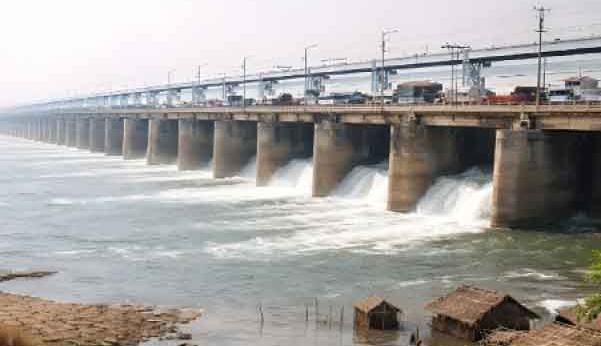
At the center of this dispute stands the Farakka Barrage, a structure whose strategic significance has grown steadily since its commissioning in 1975. Located in Murshidabad district of West Bengal, just ten kilometers from the Bangladesh border, Farakka was originally designed to redirect water into the Hooghly River in order to maintain the navigability of the Kolkata port. For India, the barrage has been essential to sustaining river transport, supporting irrigation networks, and supplying water to industrial infrastructure including the Farakka Thermal Power Plant.
For Bangladesh, however, Farakka has long symbolized the asymmetry of upstream power. Dhaka has repeatedly argued that upstream diversion reduces the natural flow of the Padma, the name the Ganges takes after entering Bangladesh, thereby accelerating salinity intrusion, degrading ecosystems, and threatening agricultural productivity across the southwestern region of the country.
The ecological consequences are difficult to ignore. Increased salinity has damaged soil fertility in coastal districts, fish production has declined in several river systems, and sediment accumulation in the lower delta is altering navigation channels. Roughly two million tonnes of silt are estimated to settle in the region each year, compounding the environmental strain.
India counters with its own concerns. Officials argue that the Hooghly River faces severe navigational challenges without water diversion at Farakka. Reduced flow, they say, threatens port operations and disrupts power generation. In other words, both sides view the same river through entirely different strategic lenses.
A History of Temporary Fixes
The 1996 treaty was not the first attempt to regulate water sharing between the two countries. The dispute stretches back decades. In 1977, a five-year agreement was concluded between Indian Prime Minister Morarji Desai and Bangladeshi President Ziaur Rahman. Subsequent memorandums of understanding were signed in 1982 and again in 1985, each providing short-term arrangements but failing to create a durable framework.
The 1996 treaty was meant to resolve that uncertainty by establishing a long-term structure lasting thirty years. Yet even that agreement has struggled to operate smoothly. Seasonal water shortages frequently prevent the full implementation of the treaty’s flow guarantees, particularly during the peak dry months.
Every year between January and May, joint teams from India’s Central Water Commission and Bangladeshi authorities measure water levels at Farakka. In theory, these measurements determine how the water should be distributed. In practice, nature rarely conforms to diplomatic formulas.
The West Bengal Factor
Adding another layer of complexity is the role of Indian state politics, particularly the government of West Bengal. Chief Minister Mamata Banerjee has previously accused New Delhi of attempting to negotiate water-sharing arrangements without adequately consulting the state government. Her opposition famously derailed the proposed Teesta River agreement in 2011, demonstrating how regional political considerations can override national diplomacy.
Given that Farakka lies within West Bengal’s territory, the state’s interests cannot be ignored in any renegotiation of the Ganges treaty. Agricultural needs, local irrigation demands, and political sensitivities all influence the state government’s position. This internal dimension of Indian politics makes any future agreement significantly more complicated.
India’s Emerging Water Diplomacy
Recent developments elsewhere in South Asia have also reshaped perceptions of India’s water strategy. In 2025, India unilaterally suspended the Indus Waters Treaty of 1960 with Pakistan, a move that many analysts interpreted as a dramatic shift in New Delhi’s approach to transboundary rivers.
The decision signaled that water agreements once considered untouchable could, under certain political conditions, be revisited or even abandoned.
For policymakers in Dhaka, the message was unmistakable: river treaties are no longer purely technical instruments. They can be deployed as tools of geopolitical leverage. This reality raises uncomfortable questions about the future of the Ganges agreement.
Bangladesh’s Strategic Calculations
Bangladesh historically preferred bilateral negotiation with India on water disputes. However, Dhaka’s recent announcement that it intends to join the 1997 United Nations Convention on the Law of the Non-Navigational Uses of International Watercourses suggests a potential shift toward internationalizing the issue.
Such a move would introduce legal norms emphasizing equitable and reasonable utilization of shared rivers, potentially strengthening Bangladesh’s bargaining position. At the same time, Dhaka must weigh the risks of confrontation.
India remains one of Bangladesh’s largest trading partners and an essential supplier of electricity. Cross-border transit arrangements also allow India to connect its northeastern states with the mainland.
In this interconnected environment, water cannot be separated from other strategic interests. Diplomacy, therefore, is likely to revolve around a concept known as “issue linkage” where negotiations over water are tied to agreements on trade, connectivity, and energy cooperation
.
.
A Treaty at the Edge
India is reportedly considering a renegotiated framework lasting only ten to fifteen years rather than the previous thirty-year arrangement. Some discussions within Indian policy circles have also suggested increasing India’s water allocation during certain critical periods of the dry season.
For Bangladesh, such proposals raise concerns about long-term water security. The country’s southwestern region already faces mounting environmental stress. Reduced river flow exacerbates salinity intrusion in coastal districts and threatens agricultural livelihoods for millions of people. From Dhaka’s perspective, the Ganges treaty is not a diplomatic document. It is a safeguard for ecological survival.
The Stakes of 2026
If a new agreement is not reached before December 2026, the consequences could extend far beyond water management. The absence of a treaty would inject uncertainty into one of South Asia’s most critical river systems. It could also intensify political debates within Bangladesh about sovereignty and dependence on India.
For New Delhi, the challenge is equally delicate. Using water as leverage may yield short-term bargaining advantages, but it risks eroding trust in one of India’s most important regional partnerships.
The River as a Test of Power
Ultimately, the future of the Ganges treaty will reveal whether South Asia can sustain cooperative management of shared rivers in an era of shifting political alignments. For India, the temptation to convert hydrological advantage into strategic influence is increasingly evident. For Bangladesh, the task is to defend its water rights while preserving the economic ties that bind the two countries together. Between these competing imperatives flows the Ganges, a river whose currents now carry the weight of regional power politics.
And as the treaty’s expiration approaches, one reality becomes clear: the struggle over the Ganges is no longer about water alone. It is about who controls the future of South Asia’s most vital lifelines. Bangladesh’s new government needs to tackle the issue carefully and always keep in mind the sovereignty issue of Bangladesh first.