

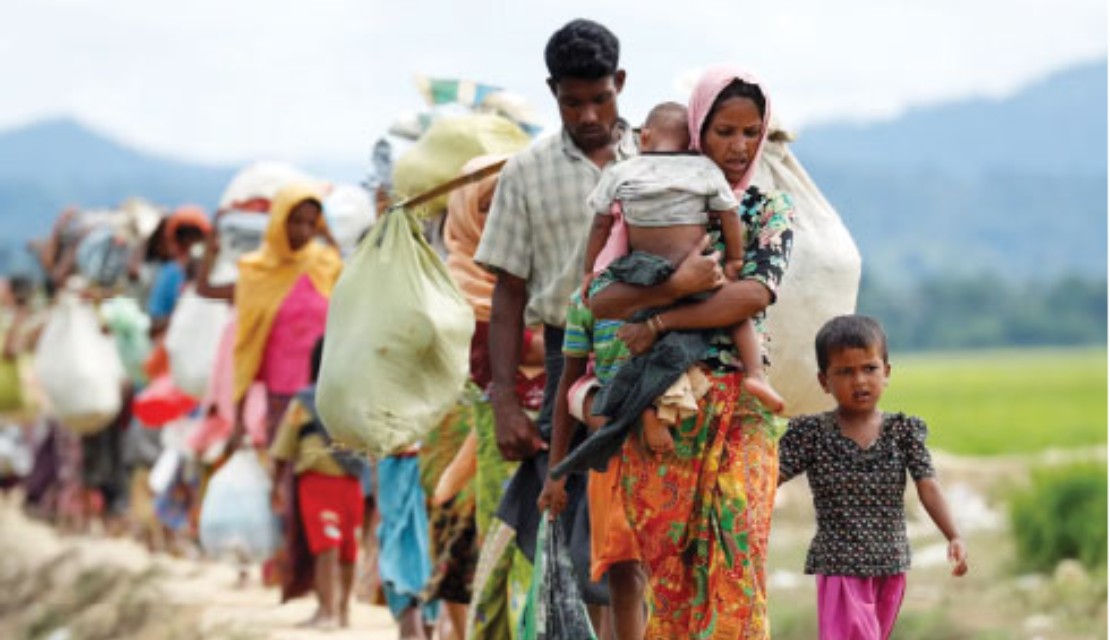
The architecture of global empathy is crumbling, replaced by the cold, unforgiving mechanics of regional realpolitik. When the desperate exodus of the Rohingya people flooded across the borders into Bangladesh in the autumn of 2017, the global community approached the catastrophe through a dangerously simplistic paradigm. The narrative was neatly packaged for evening broadcasts: a brutal military apparatus in Naypyidaw had displaced a persecuted minority, a benevolent neighbor in Dhaka had opened its doors in a monumental act of humanitarianism, and Western moral outrage would eventually force a peaceful repatriation. Nearly a decade later, that naive framework lies in absolute ruin.
We are no longer managing a refugee crisis; we are standing at the epicenter of a permanent geopolitical mutation. The prolonged presence of the Rohingya within the sovereign borders of Bangladesh has ceased to be just a demographic burden. It has intricately woven itself into the very fabric of the nation’s economic stability, its fragile border security apparatus, the shadowy rivalries of Asian superpowers, and the trajectory of its future foreign policy. To believe that returning to the status quo of 2017 is still possible is not just diplomatic optimism; it is strategic negligence.
We are no longer managing a refugee crisis; we are standing at the epicenter of a permanent geopolitical mutation. The prolonged presence of the Rohingya within the sovereign borders of Bangladesh has ceased to be just a demographic burden. It has intricately woven itself into the very fabric of the nation’s economic stability, its fragile border security apparatus, the shadowy rivalries of Asian superpowers, and the trajectory of its future foreign policy. To believe that returning to the status quo of 2017 is still possible is not just diplomatic optimism; it is strategic negligence.
The battleground of Rakhine State has transformed into a kaleidoscopic landscape of shifting allegiances and fragmented power. The central apparatus of Myanmar, the embattled military junta, the fiercely capable Arakan Army, local ethnic factions, and the colossal economic gravitational pull of major global powers are now hopelessly entangled. Consequently, the equation for Rohingya repatriation is no longer a bilateral negotiation confined to the diplomatic corridors of Dhaka and Naypyidaw. It is now inextricably tethered to the future structural survival of Rakhine itself. For Bangladesh, a terrifying but necessary new strategic reality begins the moment the map changes.
The Illusion of Westphalian Sovereignty
If the territorial map fundamentally changes, the entire mathematical calculus of repatriation must inevitably change with it. For years, the diplomatic machinery of Bangladesh operated on a strictly state-centric doctrine. The logic was rooted in classical Westphalian sovereignty: the central government of Myanmar holds the legal title to Rakhine; therefore, all dialogue regarding the return of displaced populations must be directed toward Naypyidaw. In the sterilized halls of international law, this posture is entirely logical. On the muddy, blood-soaked ground of Rakhine, it is increasingly absurd.
In the brutal theater of international relations, legal sovereignty and effective territorial control are rarely the same animal. When attempting to engineer the mass return of over a million traumatized people, it is impossible to ignore the entities that actually hold the weapons, administer the checkpoints, and dispense justice in the valleys where these people are supposed to live. Here, Bangladesh is forced to walk a geopolitical tightrope suspended over a chasm. Engaging with the Arakan Army presents a severe diplomatic hazard. To formally communicate with them could be interpreted as granting them political legitimacy, potentially triggering the wrath of the central state. Yet, to pretend they do not exist while they effectively govern vast swathes of the repatriation zone is a strategy of willful blindness. Dhaka must calculate the severe complications that any level of recognition might trigger. More critically, it must ruthlessly assess whether these emerging de facto powers possess the slightest genuine intention of granting the Rohingya population their basic civic rights upon return.
To navigate this, we must ask the single most important question of the coming decade: Who actually rules Rakhine? The answer cannot be deciphered by looking at a military map or a UN charter. It is found by observing who is collecting the taxes, who is securing the borders, who is maintaining civil order, and fundamentally, what political identity will be forcefully assigned to the returning Rohingya. Because of this shattered reality, Bangladesh cannot rely on a generic "Myanmar Policy." It requires a highly specialized, surgically precise "Rakhine Strategy." While a national policy views the state as a monolith, a Rakhine-specific doctrine must dissect the micro-dynamics of power, the localized economy, shifting demographics, and the future political architecture of that specific soil. This is not an endorsement of separatist rebellions; it is the absolute necessity of aligning grand strategy with ground truth.
The Rakhine Power Matrix (2026 Estimates)

The Dragon’s Calculus: Risk and Opportunity
China represents a monumental dimension of the Rakhine equation, casting a long, intricate shadow over the Bay of Bengal. The highly touted China-Myanmar Economic Corridor (CMEC) and the multi-billion-dollar Kyaukphyu deep-sea port are not simply altruistic development projects meant to uplift a struggling neighbor. They are the physical anchors of Beijing’s grand strategy to establish a permanent economic and naval presence in the Indian Ocean. There is a fundamental law of geopolitics at play here: infrastructure does not merely facilitate trade; it permanently alters the geopolitical gravity of a region.
The tighter the logistical connectivity between the Kyaukphyu coastline and the landlocked Chinese interior, the more critical this corridor becomes to bypassing traditional maritime chokepoints. Yet, the geographical bedrock of this entire multi-billion-dollar ambition is Rakhine State. Should Rakhine disintegrate into a zone of endless, multi-factional warfare, Beijing’s investments will sink into the mud. This acute vulnerability offers Bangladesh a rare and potent instrument of diplomatic leverage.
However, Dhaka must tread with extreme caution. It would be a catastrophic miscalculation to allow Beijing's sweeping geopolitical ambitions to dictate Bangladesh’s sovereign foreign policy. The objective must be a sophisticated diplomacy that utilizes Chinese influence to break diplomatic deadlocks, rather than a diplomacy that becomes hopelessly dependent on Chinese goodwill. Dhaka must decode Beijing’s core interests and engineer a scenario where fulfilling those interests simultaneously resolves the refugee burden, without dragging Bangladesh into the crossfire of superpower rivalries.
The question Dhaka must pose to Beijing is direct and unsparing: If long-term commercial stability is the ultimate goal in Rakhine, how does China propose to guarantee the long-term political and humanitarian stability required to protect it? The mass repatriation of the Rohingya must be irreversibly linked to this very question.
If Beijing intends to architect the economic resurrection of Rakhine, the societal rehabilitation of the Rohingya must be written into the blueprint. Economic corridors, civil stability, infrastructure reconstruction, and human repatriation. These four pillars must be fused into an inseparable strategic package.
To achieve this, Bangladesh must draw a definitive red line in the sand. No regional infrastructure mega-project, no port development, and no transit corridor should be allowed to advance while the issues of Rohingya citizenship and safe return are ignored. Dhaka’s masterstroke would be to reframe the narrative, forcing the world to view humanitarian rights and geo-economic profit not as opposing forces, but as mutually dependent prerequisites.
The Stability-Investment Nexus

The Contagion in the Hills
While international cameras remain fixated on the sprawling mega-camps of Cox’s Bazar, a far more insidious threat simmers in the background. The Chittagong Hill Tracts (CHT) have been criminally overlooked in the broader discourse of the crisis. The unforgiving geographical reality dictates that Rakhine State and the CHT belong to the exact same continuous, bleeding border-security ecosystem.
Characterized by dense, impenetrable forests and treacherous mountainous terrain, this region is a paradise for the illicit trafficking of military-grade weaponry, synthetic narcotics, and human cargo. The potential cross-pollination between battle-hardened armed factions in Myanmar and dormant insurgent elements within Bangladesh’s own borders is a nightmare scenario. Securing this frontier cannot be relegated to underfunded border guards patrolling with binoculars
A vital note of analytical caution is necessary here. Any sensationalist claims regarding active operational alliances between Rakhine insurgents and Bangladeshi hill-tract militias must never be elevated to national policy without rigorous, undeniable intelligence verification. Weaponizing unsubstantiated paranoia will only ignite new, uncontrollable fires. Instead, Bangladesh must revolutionize its border management doctrine, pivoting aggressively toward advanced signals intelligence, deep human intelligence networks, drone surveillance, and seamless inter-agency operational synergy.
The Threat Vectors
The Threat Vectors

Engineering the Return: A Blueprint for Sovereignty
Perhaps the most tragic failure of the past decade is that the Rohingya dilemma was imprisoned within the soft, ineffective realm of humanitarian diplomacy. While delivering rations and medicine is a moral imperative, reversing a mass exodus requires the hard edge of statecraft. Repatriation is a brutal logistical and political science.
It must encompass military security, international jurisprudence, economic regeneration, and regional deterrence. Before a single family crosses the border back into Myanmar, an ironclad political and economic matrix must be constructed to absorb them. Who will legally enforce their right to own the soil they farm? Who guarantees they will not be slaughtered in the night? What is their exact legal standing in the eyes of the local warlords? Without concrete answers, repatriation is merely returning victims to their executioners.
Bangladesh must abandon passive requests and unilaterally present a rigid, non-negotiable architectural framework for return. This cannot be vague; it must be a sequential, six-stage mechanism:
1. Verification Protocol: A modernized, internationally audited system to definitively establish historical identities, bypassing Myanmar’s deliberate destruction of civil records.
2. Consent Mechanisms: An undeniable, transparent process ensuring that the return is entirely voluntary, stripping away any accusations of forced deportation.
3. Security Guarantees: The establishment of monitored safe zones where physical safety and unrestricted freedom of movement are guaranteed by a coalition of regional observers.
4. Civic Rights Restoration: An uncompromising commitment to citizenship, the return of stolen ancestral property, and access to the fundamental machinery of a state.
5. International Monitoring: The permanent deployment of independent verifiers to ensure that promises made on paper are not violated in the shadows.
6. Reconstruction Architecture: The immediate mobilization of capital to rebuild burned villages, construct medical facilities, and establish sustainable agricultural livelihoods.
Attempting to move people outside this rigid sequence guarantees a second collapse. We need timelines, but we must discard the folly of arbitrary "deadline diplomacy."
The passage of time is our greatest enemy. Every five years that pass means an entirely new generation of children is born into the despair of barbed wire, international donor fatigue accelerates, the allure of criminal extremism deepens, and the social friction with the exhausted local Bangladeshi host communities inches closer to a violent ignition point.
Therefore, Dhaka should engineer a rolling, conditional 36-month diplomatic roadmap. This is not a countdown to forced expulsion; it is a tactical schedule for accountability.
The 36-Month Accountability Matrix


The Masterclass in Multi-Vector Balancing
To survive this ordeal, placing all of Bangladesh’s strategic chips on a single superpower would be an error of historic proportions. In this grand game, everyone matters, but no one is a savior. Beijing is vital for its supreme economic leverage over Myanmar. New Delhi is indispensable for maintaining the broader stability of the South Asian subcontinent. Washington and Brussels wield the indispensable weapon of human rights sanctions and global financial pressure. ASEAN must be weaponized as the immediate regional political theater, while the United Nations remains the ultimate arbiter of international legitimacy. And critically, the splintered menagerie of internal forces within Myanmar cannot be ignored.
Bangladesh must execute a flawless multi-vector strategy. It must simultaneously welcome Chinese infrastructural capital while cooperating intimately with Indian intelligence to lock down the borders. It must channel Western outrage into actionable political pressure while using ASEAN to shame Naypyidaw in its own backyard. This highly complex, omnidirectional posture is the only reliable survival mechanism for a rapidly rising middle power surrounded by giants.
The ultimate question hovering over the nation is existential: Will Bangladesh remain a passive victim merely managing a permanent crisis, or will it seize the narrative and aggressively dictate the terms of its resolution? As we cross the threshold of a decade into this tragedy, there is no more critical inquiry. Dhaka must author a brand new strategic algorithm—one where Chinese maritime ambitions are hijacked for leverage, where the Arakan Army’s territorial dominance is treated as a calculated diplomatic variable, where the charred remnants of the Myanmar state serve merely as the formal signatory, and where the absolute security of the Chittagong Hill Tracts is defended as an impenetrable red line.
Where does a nation like Bangladesh find the strength to enforce such an audacious strategy? It is not found in the stockpiles of a massive military. It is forged in the undeniable realities of its geography, the immense demographic weight of its population, its highly coveted strategic positioning on the edge of the Bay of Bengal, and most importantly, the untouchable moral legitimacy it earned by bearing the weight of one of the century’s darkest atrocities. If these elements are utilized in isolation, they are merely talking points. If they are synthesized into a coordinated geopolitical weapon, Bangladesh’s bargaining power becomes formidable.
This crisis is no longer just a crushing economic and social burden; it is the ultimate crucible for Bangladesh's foreign policy apparatus. True victory in this arena means far more than watching the last refugee cross the river back home. It means successfully architecting an entirely new regional ecosystem where the stabilization of Rakhine, the uncompromising protection of Rohingya rights, the impenetrable security of Bangladesh, and the lucrative expansion of regional trade routes all feed into one another harmoniously, rather than tearing each other apart.
The era of waiting patiently in the antechambers of global powers, hoping someone else will write the conclusion to this nightmare, is permanently over. The moment demands the birth of a sovereign "Rakhine Strategy." It must be a doctrine forged in Dhaka, relentlessly focused on executing a sustainable, dignified return of a broken people, while simultaneously ensuring that the gears of the Bangladesh-Myanmar-China corridor turn, and the vital deep-sea energy reserves of the Bay are secured. It is time for Bangladesh to stop reacting to the geopolitical weather, and start making it.