
The geopolitics of the Middle East are frequently analyzed through the lenses of military skirmishes and macro-economic adjustments. Yet the most profound structural shifts often occur within the quiet corridors of statecraft where sacred geography is systematically redesigned. Recent disclosures indicating a coordinated effort between Washington and Tel Aviv to terminate Jordan's historic custodianship over the Al-Aqsa Mosque compound represent precisely such a shift. This development is not a routine diplomatic friction; it signifies the advanced stage of an institutional framework designed to fundamentally alter the sovereign reality of Occupied Jerusalem. By targeting the legal and historical administrative pillars that have safeguarded the site for decades, this joint strategy seeks to decouple the city from its Islamic matrix and integrate it irrevocably into the Israeli state architecture.
The Rhetoric of Inclusion as an Instrument of Statecraft
A defining characteristic of contemporary demographic and territorial engineering is its reliance on the vocabulary of Western liberal universalism. When the official structural transformation of the compound is formally publicized, it will undoubtedly be framed within an engineered discourse of multi-faith coexistence, shared heritage, and equitable access. This linguistic framework operates as an ideological smoke-screen. By utilizing progressive jargon, the underlying administrative apparatus can be overhauled without triggering immediate international legal rebukes.
The strategic objective of the Trump administration and the Israeli government is to dismantle the independent Jordanian-backed Islamic Waqf which has managed the sanctuary for centuries. In its place, Tel Aviv intends to establish a state-controlled regulatory body tasked with rebranding the third holiest site in Islam as a universalist tourist destination. This administrative replacement will effectively strip the sanctuary of its distinct Islamic legal status. Under the guise of creating a multi-faith center, the state will acquire the unprecedented authority to appoint religious officials, vet the theological content of Friday sermons, and regulate ecclesiastical leadership. Liberal terminology is thus deployed to execute a profound exercise in state-sanctioned co-optation, transforming a living axis of Islamic civilization into a managed heritage park subject to security oversight.
The Micro-Politics of Attrition
This projected administrative takeover does not emerge from a vacuum; it represents the institutionalization of a long-standing creeping annexation. The erosion of the historical status quo has been achieved through an incremental strategy of spatial and demographic attrition. Over several years, the physical and regulatory boundaries governing the compound have been systematically modified to favor state priorities.
The transition from a Muslim-administered sanctuary to a state-dominated space is explicitly visible in the shifting demographics of access.
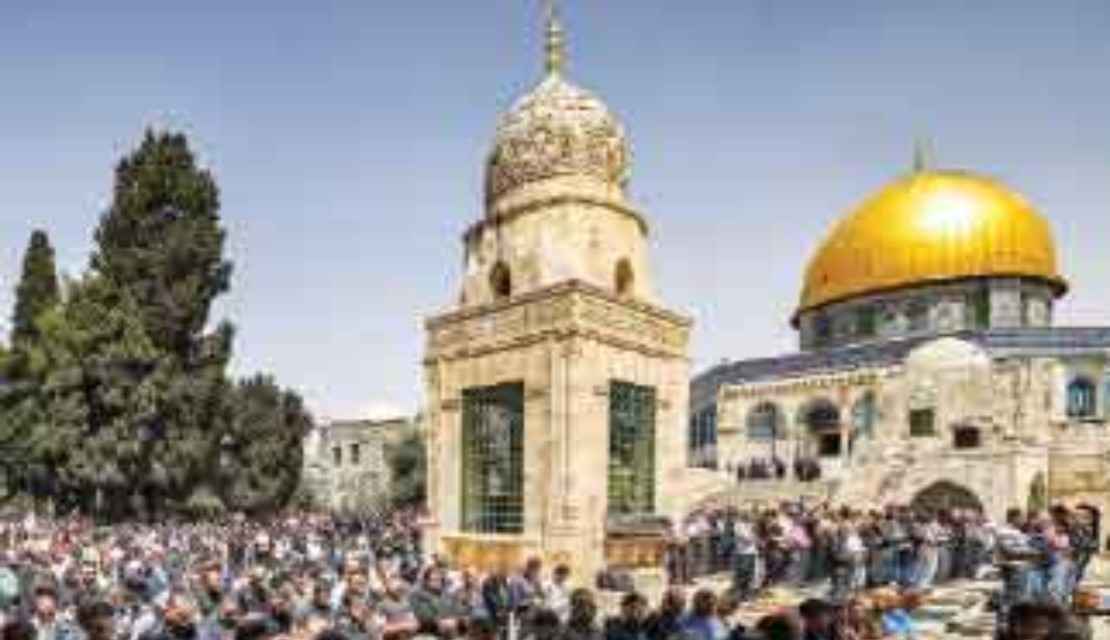
The quantitative transformation of daily life at the compound provides undeniable evidence of this trajectory. While the site historically gathered hundreds of thousands of worshippers for congregational prayers, systematic checkpoints, persistent harassment, and bureaucratic restrictions have reduced daily attendance to minuscule fractions. Simultaneously, state-protected groups enter the compound with increasing frequency, particularly during national and religious holidays. This asymmetric access policy is designed to normalize an external presence while systematically pricing out the indigenous population through security costs and legal prohibitions. As noted by field researchers, these religious visits serve an underlying nationalistic purpose, gradually establishing state dominance over the geography under the banner of religious freedom.
Access Metrics and Administrative Restraints (Current Year)
Palestinians banned from the compound: > 600
Waqf personnel entry permits revoked: 30
Religious leaders/Imams systematically silenced: 6
This data illustrates a deliberate policy of institutional decapitation. By removing the legal and spiritual guardians of the space, the state creates an administrative vacuum that can easily be filled by the proposed state-run regulatory entity. Senior religious authorities, including Al-Aqsa Imam Ekrima Sabri, have characterized these developments as an unprecedented system of subjugation designed to alter the delicate equilibrium of the city permanently.
Physical Contraction and Regional Paralysis
The administrative assault on the compound is accompanied by aggressive territorial consolidation within the surrounding urban fabric. Recent state maneuvers have focused on the expropriation of Palestinian real estate near the crucial Chain Gate artery, a vital entry point into the Old City of Jerusalem. This real estate acquisition is part of a broader, well-documented campaign to alter the demographic balance of the historic core, ensuring that the approach to the holy site is entirely mediated by state-aligned developments.
The vulnerability of the sanctuary was starkly demonstrated during recent regional military confrontations, specifically during the state’s multi-front war with Iran. For an uninterrupted duration of forty days, the Al-Aqsa Mosque was completely sealed to worshippers-an unprecedented act of total exclusion that signaled absolute sovereign control. Although eight Arab and Islamic nations issued formal diplomatic condemnations, the lack of substantive material pushback highlighted a profound imbalance of power. The temporary closure served as a successful stress-test for total state management, proving that under the pretext of security, the sanctuary could be detached from its community without inducing severe geopolitical consequences.
The Crisis of Deterrence and Global Precedents
The primary variable facilitating this rapid transformation is not merely the asymmetry of military power, but the profound institutional paralysis across the wider Islamic world. The collective response from regional capitals has been characterized by a predictable cycle of rhetorical condemnation followed by immediate passivity. State actors balance their immediate economic and security alignments against their ideological commitments, ultimately prioritizing diplomatic realpolitik over the preservation of historical treaties. This structural apathy sends a clear signal to policymakers in Washington and Tel Aviv that the political cost of redefining Jerusalem’s sovereignty is entirely manageable.
Geopolitical Cycle of Attrition
State Incursion -> Regional Rhetoric -> Institutional Inaction -> New Status Quo Established
For the international community, the unfolding strategy in Jerusalem establishes a highly destabilizing precedent in global governance. It demonstrates that prolonged, incremental territorial modification-when paired with sufficient imperial backing and wrapped in the language of pluralistic harmony-can successfully rewrite international law and erase indigenous histories. The documentation compiled by independent monitoring groups like the Arab Organisation for Human Rights clearly outlines the systemic nature of these maneuvers. To treat this crisis as a localized real estate dispute or a minor religious disagreement is to misunderstand the nature of modern colonial sovereignty.
The timeline for intervention has narrowed drastically. Without immediate, concerted pressure involving concrete legal, economic, and diplomatic mechanisms, the historical character of Jerusalem will be fundamentally transformed. The language of multi-faith tolerance is being effectively weaponized to finalize a structural dispossession that has been decades in the making, rendering the preservation of this global heritage site an urgent test of international legal credibility.