

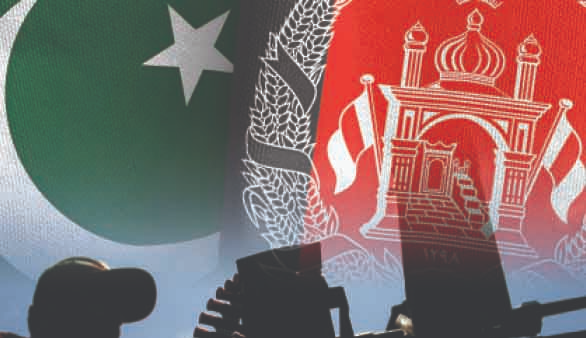
South Asia is once again approaching a dangerous inflection point. What began as a series of retaliatory strikes along a volatile frontier now threatens to evolve into something far more consequential: a prolonged military confrontation between two neighboring states already struggling with fragile internal security environments. The escalating hostility between Pakistan and Afghanistan should not be seen as an isolated border dispute. It is part of a larger geopolitical tremor rippling across Asia that connects regional rivalry, and the destabilizing effects of wider conflicts stretching from the Middle East to the Indian subcontinent.
In recent days, the intensity of hostilities between Islamabad and Kabul has reached a level not witnessed in years. Pakistani forces conducted air strikes across more than twenty locations inside Afghanistan, reportedly including areas near the capital and key urban centers. Taliban fighters responded by targeting numerous Pakistani border installations, transforming what had long been sporadic cross-border friction into a much broader military confrontation.
What makes this confrontation particularly alarming is not merely the scale of the strikes but their timing. These clashes unfolded just as tensions across the Middle East were rising sharply following attacks involving Iran and regional actors backed by United States and Israel. In a geopolitical environment already strained by overlapping crises, the possibility that South Asia could ignite another conflict zone carries consequences far beyond the region itself.
What makes this confrontation particularly alarming is not merely the scale of the strikes but their timing. These clashes unfolded just as tensions across the Middle East were rising sharply following attacks involving Iran and regional actors backed by United States and Israel. In a geopolitical environment already strained by overlapping crises, the possibility that South Asia could ignite another conflict zone carries consequences far beyond the region itself.
Yet the roots of the Afghanistan-Pakistan confrontation are neither sudden nor mysterious. Since the Taliban regained power in 2021, relations between Islamabad and Kabul have steadily deteriorated despite their complicated history as wartime partners during the U.S.-led campaign in Afghanistan.
Pakistan once served as a crucial sanctuary for Taliban fighters and leadership networks during the two-decade war. But that relationship, forged out of strategic necessity, has gradually turned into mutual suspicion. At the center of the dispute lies the growing threat posed by Tehreek e Taliban Pakistan (TTP). Islamabad argues that the militant organization has been operating freely from Afghan territory and launching an increasing number of attacks inside Pakistan since the Taliban returned to power. From the Pakistani perspective, Kabul has either been unwilling or unable to dismantle the infrastructure supporting the group.
The concern is not trivial. The TTP previously orchestrated one of the most devastating insurgent campaigns in Pakistan’s modern history. Between 2007 and 2014, the organization carried out large-scale terrorist operations across the country, attacking military installations, civilian targets, and government institutions. A series of military operations by the Pakistani army significantly weakened the group, but many militants fled across the border into Afghanistan.
Since the Taliban’s return to power, Islamabad believes those fighters have found renewed operational space. The resurgence of attacks within Pakistan has reinforced the perception among its security establishment that Afghanistan is again becoming a sanctuary for anti-Pakistani militants.
Taliban officials strongly reject these accusations. They insist that Afghanistan will not be used as a base for attacks against other countries. Yet historical realities complicate those claims. The Taliban and the TTP share deep ideological and operational connections that date back decades. They have fought side by side in multiple campaigns, and their leadership structures have long intersected.
One of the earliest leaders of the TTP, Baitullah Mehsud, was previously linked to the notorious Haqqani Network, a powerful faction within the broader Taliban movement known for some of the most ruthless insurgent operations during the Afghan war.
Such ties make a decisive Taliban crackdown against the TTP highly unlikely. For the Taliban leadership, turning against longtime allies would not only damage internal cohesion but could also trigger serious divisions within their own ranks. Even more dangerously, it could push disgruntled fighters toward the Taliban’s fiercest regional rival: Islamic State Khorasan Province.
The Taliban leadership understands this risk well. The Islamic State affiliate has repeatedly targeted Taliban officials and institutions, seeking to undermine the movement’s authority in Afghanistan. Any attempt by Kabul to forcibly suppress the TTP could inadvertently strengthen the very extremist organization that poses the most direct threat to Taliban rule.
Beyond ideological considerations, there are strategic reasons why the Taliban has little incentive to accommodate Pakistan’s demands. Although Islamabad played a crucial role in sustaining the Taliban during their insurgency, the geopolitical landscape has shifted dramatically since the war ended. The Taliban no longer depends on Pakistani sponsorship in the way it once did. As a result, Pakistan’s leverage over Kabul has eroded significantly.
This erosion of influence has fueled growing frustration within Pakistan’s security establishment. For decades, Pakistani strategists believed that their historical relationship with the Taliban would ensure a cooperative government in Kabul. Instead, they now confront a regime that increasingly asserts its independence and refuses to align fully with Pakistan’s security priorities.
The situation becomes even more complex when viewed through the lens of broader regional instability. The conflict surrounding Iran has the potential to spill over into Pakistan’s southwestern province of Balochistan, an area already plagued by separatist insurgencies and militant networks. Any instability along Pakistan’s western borders could embolden insurgent groups seeking greater autonomy or outright independence.
For separatist movements operating in Balochistan, a distracted Pakistani state would represent a strategic opportunity. Simultaneously, the TTP could exploit the situation to intensify its own campaign of attacks. The result would be a multi-front security crisis stretching from Pakistan’s mountainous northwest to its volatile southwestern frontier.
Compounding these challenges is Pakistan’s enduring rivalry with India. The two nuclear-armed neighbors have a long history of confrontation, and tensions between them remain persistently high. Their latest crisis earlier this year marked the most serious military confrontation between the two countries.
From New Delhi’s perspective, worsening relations between Pakistan and Afghanistan could present strategic advantages. A Pakistan forced to divide its attention between multiple internal and external security challenges would inevitably have fewer resources to devote to its eastern border. For India’s strategic planners, such a scenario weakens a long-standing adversary without requiring direct confrontation.
Indeed, many analysts believe that India quietly benefits from instability along Pakistan’s western frontier. The more Islamabad becomes entangled in conflicts with militant groups and neighboring states, the less capable it becomes of projecting influence in the broader region.
This geopolitical reality adds yet another layer of complexity to the Afghanistan-Pakistan crisis. Regional rivalries often exploit internal conflicts, and South Asia is no exception. When strategic competition intersects with insurgency and fragile governance, the result can be a dangerous cycle of escalation.
Diplomatic attempts to ease tensions between Islamabad and Kabul have so far produced limited results. Several rounds of negotiations facilitated by regional actors. Yet these agreements have consistently collapsed after new rounds of violence.
The underlying problem is that the fundamental dispute remains unresolved. Pakistan insists that Afghanistan must dismantle the TTP infrastructure operating on its territory. The Taliban, meanwhile, refuses to take actions that could threaten its internal unity or provoke backlash from allied militant networks.
Given these conditions, the likelihood of lasting stabilization appears slim. The most optimistic scenario would involve renewed diplomatic mediation leading to another fragile cease-fire. But such an outcome would merely postpone the next crisis rather than resolve the underlying tensions.
A more probable scenario involves continued low-intensity conflict. Pakistan may persist with targeted air strikes against suspected militant positions inside Afghanistan, while Taliban forces retaliate through border operations. Each side might seek to avoid full-scale war while still demonstrating resolve.
A more probable scenario involves continued low-intensity conflict. Pakistan may persist with targeted air strikes against suspected militant positions inside Afghanistan, while Taliban forces retaliate through border operations. Each side might seek to avoid full-scale war while still demonstrating resolve.
Even this restrained version of conflict would leave the region in a precarious state. The latest clashes have already exceeded the geographic and operational scope of previous confrontations. The normalization of such military exchanges risks gradually lowering the threshold for escalation.
The most dangerous possibility, however, cannot be dismissed. If Pakistan concludes that limited strikes are insufficient to curb cross-border militancy, it could expand its air campaign across Afghan territory. Such a strategy would likely target both TTP networks and Taliban military infrastructure.
In response, the Taliban could escalate dramatically. The group might intensify border operations while simultaneously encouraging allied militant organizations to carry out attacks inside Pakistan’s major cities. A conflict that began along remote mountain frontiers could rapidly spread into densely populated urban centers.
Such an escalation would inevitably draw international attention. Yet global powers may have limited capacity to intervene effectively. The United States, already preoccupied with crises in the Middle East and other regions, may find its diplomatic bandwidth severely constrained.
Ironically, the very actors best positioned to mediate, Saudi Arabia and Qatar are themselves increasingly absorbed by the geopolitical consequences of the expanding confrontation involving Iran. Their ability to act as neutral intermediaries in South Asia may therefore be diminished.
All of this leaves the Afghanistan-Pakistan relationship perched on an unstable edge. Decades of war, ideological alliances, and strategic miscalculations have produced a volatile environment in which mistrust outweighs cooperation.
The tragedy is that both countries have much to lose from prolonged conflict. Afghanistan is struggling to stabilize after decades of war and international isolation. Pakistan faces severe economic pressures and an already complicated internal security landscape. Yet geopolitics often rewards confrontation over compromise. External rivalries, militant networks, and regional ambitions continue to shape decisions in both capitals.
If diplomacy fails once again, the result could be a dangerous new theater of conflict in South Asia, one that not only destabilizes two fragile states but also reshapes the strategic balance across the entire region.